

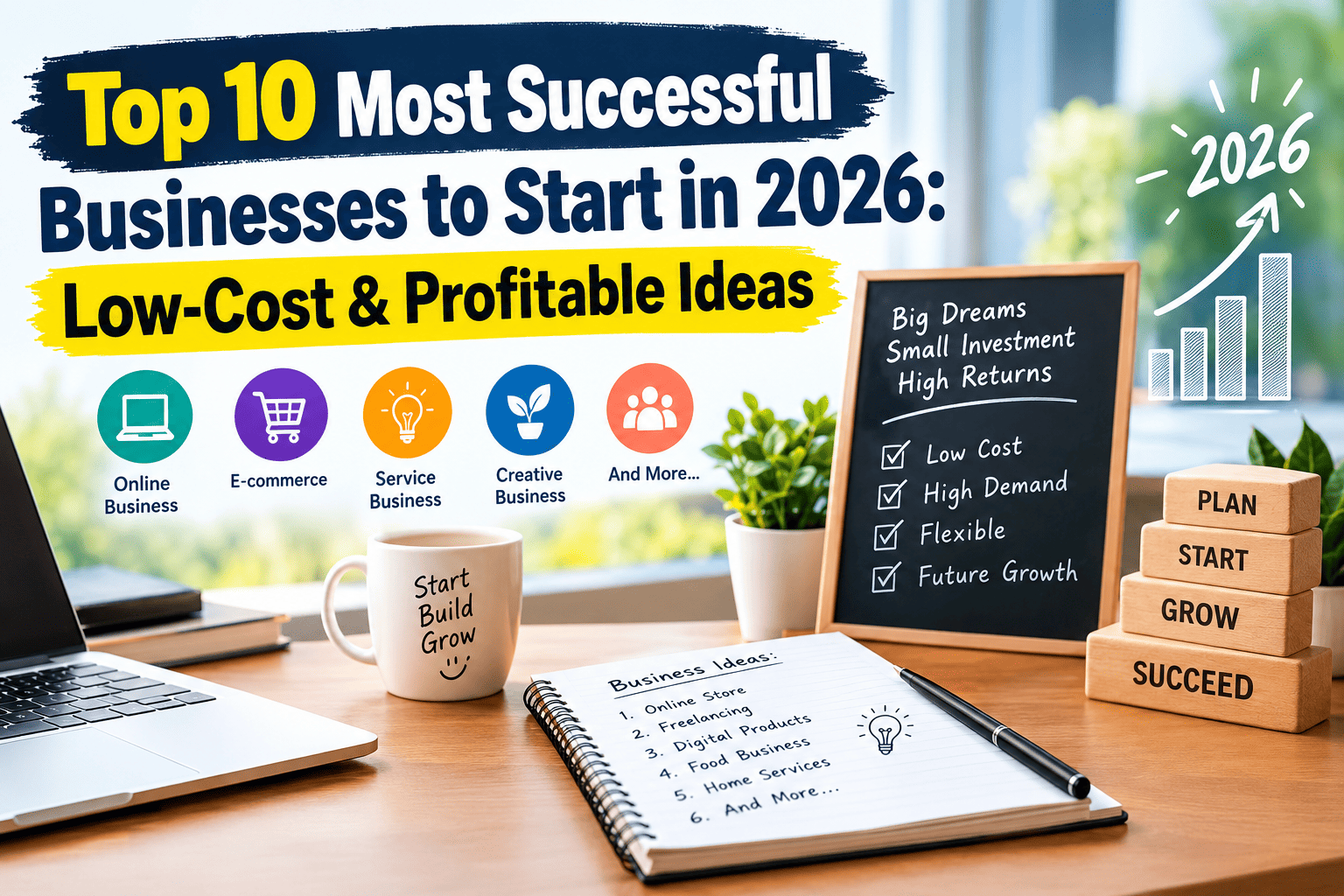
Starting a business in 2026 does not always require a large investment, expensive office, or a big team. Many successful businesses can now be launched from home with a laptop, internet connection, practical skills, and a clear understanding of what customers need. Service-based businesses, digital products, AI-related services, ecommerce, and specialized local services are among the opportunities attracting new entrepreneurs this year.
However, choosing a business simply because it is trending is not enough. A strong business idea should solve a real problem, have customers willing to pay, offer reasonable startup costs, and give you a realistic path toward sustainable revenue. This guide explores the top 10 most successful businesses to start in 2026, with a focus on ideas that can be started with relatively low investment and expanded over time.
What Makes a Business Successful in 2026?
Before choosing an idea, it helps to understand what makes a business attractive. Businesses with low overhead, recurring customers, strong demand, and opportunities for scalability generally have an advantage. Digital and service businesses can be particularly appealing because entrepreneurs can often start by selling their skills rather than purchasing large amounts of inventory.
Another important factor is flexibility. A business that allows you to begin part-time, test demand, and reinvest early revenue can reduce the financial pressure associated with launching a new company.
With that in mind, here are ten business models worth considering in 2026.
1. AI and Automation Services
Artificial intelligence has created new opportunities for entrepreneurs who can help businesses use technology more effectively. Small companies may want help with AI-powered customer support, workflow automation, content systems, data organization, appointment processes, or internal productivity tools.
You do not necessarily need to develop an advanced AI model yourself. The opportunity can come from understanding existing tools and using them to solve specific business problems. For example, an entrepreneur could create automated lead-response systems for local businesses or help companies organize repetitive administrative tasks.
The strongest approach is to focus on a specific customer group rather than offering vague “AI services.” A specialized service is easier to explain, market, and improve.
Best for: Tech-minded entrepreneurs, freelancers, and people comfortable learning new software.
2. Digital Marketing and Social Media Management
Businesses need customers, and many small companies struggle to maintain their online presence. This creates opportunities for digital marketing specialists who can manage social media, create content, improve websites, run campaigns, or develop basic SEO strategies.
One advantage of this model is its relatively low startup cost. You can begin with a computer, internet connection, appropriate software, and your own marketing skills. Current small-business guides continue to list digital marketing and social media services among low-cost opportunities.
Instead of trying to serve everyone, consider specializing in one industry such as restaurants, real estate, fitness businesses, ecommerce stores, or professional services. A niche can make your offer more relevant and help you build expertise faster.
3. Freelance Writing, Design, and Creative Services
Freelancing remains one of the simplest ways to turn an existing skill into a business. Writers, graphic designers, video editors, website developers, translators, and other specialists can sell their services directly to businesses and individuals.
The initial investment can be very small because you are primarily selling expertise and time rather than physical products. The bigger challenge is building a portfolio and consistently finding clients.
Over time, freelancers can move beyond hourly work by creating packages, monthly retainers, or specialized services. This can make income more predictable and create opportunities to eventually hire other freelancers.
4. Online Courses and Digital Products
Digital products are attractive because they can be created once and sold repeatedly. Examples include ebooks, templates, spreadsheets, design assets, educational resources, downloadable guides, and online courses.
The main investment is usually knowledge, research, creation time, and marketing rather than inventory. Shopify also identifies digital products and online courses among low-cost business opportunities for 2026.
The key is to solve a specific problem. Instead of creating a broad course about “business,” for example, a creator could develop a practical course teaching beginners how to create their first online store or manage social media for a small company.
5. Niche Ecommerce Store
Ecommerce remains an important business opportunity, but starting a successful online store requires more than uploading random products. A niche store focuses on a particular audience and builds its product selection around that audience’s needs.
You could sell specialty clothing, home accessories, hobby products, beauty items, personalized gifts, or other products with a clearly defined customer base. Print-on-demand and dropshipping can reduce the need for large amounts of inventory, while traditional ecommerce gives you greater control over products and fulfillment.
The biggest challenge is competition. A successful store needs strong product selection, reliable fulfillment, good customer service, and marketing that gives people a reason to buy from you rather than another seller.
6. Online Tutoring and Coaching
Education-based businesses can be started with relatively little equipment if you already have valuable knowledge. Online tutoring can cover school subjects, languages, professional skills, software, music, test preparation, or other areas where students need help.
Coaching can also work in specialized areas where customers are looking for guidance and accountability. The important thing is to be honest about your qualifications and experience.
This business model can begin with individual sessions and eventually expand into group classes, recorded courses, memberships, or downloadable resources.
7. Bookkeeping and Virtual Assistant Services
Many small businesses need administrative help but cannot justify hiring full-time employees. This creates opportunities for virtual assistants and bookkeeping service providers.
A virtual assistant might manage email, scheduling, customer communication, research, data entry, or routine administrative tasks. A bookkeeping business can help companies organize financial records and maintain their books, subject to applicable qualifications and local requirements.
These businesses can benefit from recurring monthly clients. That recurring relationship can be more valuable than constantly searching for one-time customers.
8. Home and Commercial Cleaning Services
Not every successful business needs to be online. Cleaning services can be started on a relatively small budget and can generate repeat business when customers are satisfied.
You can specialize in residential cleaning, offices, move-in and move-out cleaning, short-term rental properties, or specialized cleaning services. Local service businesses such as cleaning can have an advantage because customers often need them repeatedly.
As demand grows, the owner can move from doing every job personally to managing a small team. That creates a path from self-employment toward a scalable service company.
9. Mobile Car Detailing
Mobile car detailing is another practical business for entrepreneurs who prefer hands-on work. Instead of requiring customers to visit a traditional shop, the business travels to homes, workplaces, or other convenient locations.
Startup requirements depend on the level of service, equipment, transportation, and local regulations. Services can range from basic cleaning to more specialized detailing packages.
The opportunity becomes stronger when the business develops repeat customers. Monthly or seasonal detailing packages can provide more predictable revenue than relying entirely on one-time customers.
10. Pet Care and Specialized Local Services
Pet sitting, dog walking, grooming-related services, and other pet-care businesses can be attractive in communities with a large number of pet owners. Other local service opportunities include lawn care, mobile car washing, home maintenance, and specialty delivery services.
The advantage of these businesses is their direct connection with local demand. You do not necessarily need a large website or national audience to get started. A strong local reputation, referrals, clear pricing, and dependable service can become powerful marketing assets.
Pet services and other recurring local services also appear frequently in current 2026 small-business opportunity lists.
Top 10 Business Ideas at a Glance
| Business Idea | Startup Cost | Scalability | Best For |
| AI & Automation Services | Low | High | Tech-focused entrepreneurs |
| Digital Marketing | Low | High | Marketers and creatives |
| Freelance Services | Very Low | Medium–High | Skilled freelancers |
| Digital Products | Low | High | Experts and creators |
| Niche Ecommerce | Low–Medium | High | Product-focused entrepreneurs |
| Online Tutoring | Very Low | Medium–High | Teachers and experts |
| Bookkeeping & VA Services | Low | Medium–High | Organized professionals |
| Cleaning Services | Low–Medium | High | Local service providers |
| Mobile Car Detailing | Medium | High | Hands-on entrepreneurs |
| Pet & Local Services | Low | Medium–High | Community-focused businesses |
Startup costs vary considerably by location, equipment, licensing, skills, and business model. The table is intended as a general comparison rather than a guarantee of profitability.
How to Choose the Right Business for You
The most successful business idea is not necessarily the one with the highest theoretical profit. It is the one that fits your skills, available capital, market, and ability to execute.
Start by asking yourself what you already know how to do. If you have writing or design skills, a freelance service may be easier to launch than an ecommerce company. If you enjoy technology, AI automation or web services may be a better fit. If you prefer practical work, cleaning, detailing, or another local service could make more sense.
Next, research your potential customers. Find out what they currently buy, what problems they complain about, what competitors charge, and whether you can provide a better or more convenient solution.
Finally, test the idea before spending heavily. Try to get your first customer, pre-sell a service, create a simple landing page, or offer a small version of your product. Validation can help you avoid investing too much money into an idea that customers do not actually want. Current guidance on low-cost online businesses similarly recommends validating demand through market research before committing significant resources.
How to Start a Low-Cost Business in 2026
Starting small can be an advantage. Rather than spending your entire budget on branding, equipment, or an office, focus first on proving that customers will pay for your offer.
Step 1: Pick a Specific Problem
A business becomes easier to market when it solves a clear problem. Identify who your customer is and what they need help with.
Step 2: Research the Competition
Study businesses already serving your target market. Look at their prices, services, reviews, strengths, and weaknesses. Your goal is not necessarily to be cheaper; it may be better service, faster delivery, greater specialization, or a more convenient experience.
Step 3: Create a Simple Offer
Your first offer does not need dozens of features. Create one clear service or product that solves one important problem.
Step 4: Find Your First Customers
Use personal networks, local communities, social media, professional platforms, referrals, and direct outreach where appropriate. Early customers can provide valuable feedback and testimonials.
Step 5: Reinvest Carefully
Once revenue begins, reinvest in the areas that directly improve the business. That could mean better equipment, advertising, software, training, or eventually hiring help.
Common Mistakes New Entrepreneurs Should Avoid
One of the biggest mistakes is choosing a business only because someone claims it is “easy money.” Every legitimate business requires effort, customer acquisition, quality control, and financial management.
Another common mistake is trying to serve everyone. A focused audience can make your marketing and offer much clearer.
Spending too much money before validating demand is another risk. A professional logo and expensive website will not fix a business that has no customers. Start with the essentials and improve your operation as demand grows.
Finally, avoid copying competitors without adding anything valuable. Sustainable businesses usually succeed by understanding customers and offering a useful solution rather than simply reproducing what everyone else is doing.
Is It Better to Start an Online or Offline Business?
There is no universal answer. Online businesses can offer low overhead and access to customers beyond your local area. Freelancing, digital products, online tutoring, marketing, and ecommerce are examples that can often be operated remotely.
Offline businesses can have equally strong opportunities because they serve needs that require physical presence. Cleaning, car detailing, pet care, home services, and other local businesses can benefit from repeat customers and word-of-mouth referrals.
The best choice depends on your skills, budget, location, and preferred way of working.
Final Thoughts
The top 10 most successful businesses to start in 2026 are not limited to one industry. From AI and digital marketing to cleaning, ecommerce, tutoring, and pet services, there are opportunities for entrepreneurs with different skills and budgets.
The most important lesson is that a business does not become successful simply because the idea is popular. Success comes from solving a real customer problem, controlling costs, delivering consistent value, and improving the business based on actual customer feedback.
If you are starting with limited capital, consider beginning with a service or digital business that allows you to test demand before making a major investment. Once you have proven that people will pay for your offer, you can reinvest your profits and gradually build something larger.
Frequently Asked Questions
What is the best low-cost business to start in 2026?
There is no single best option for everyone. Freelancing, digital marketing, AI services, tutoring, virtual assistance, and digital products can be attractive because they can often be started with relatively low overhead.
What business can I start with little money?
Service-based businesses are usually among the easiest to start with limited capital because you can sell an existing skill before investing in inventory. Freelancing, tutoring, virtual assistance, consulting, and some local services are examples.
Are online businesses still profitable in 2026?
Yes, online businesses continue to offer opportunities, particularly in specialized services, ecommerce, digital products, education, and software-related services. However, profitability depends on demand, competition, pricing, execution, and customer acquisition.
Which business has the most potential to scale?
Digital products, software, AI services, ecommerce, online education, and specialized agencies can offer strong scalability because revenue can grow without increasing costs at exactly the same rate. However, scalability does not guarantee profitability.
Should I start a business while keeping my job?
For many beginners, starting part-time can reduce financial pressure and provide an opportunity to validate demand before leaving employment. The right approach depends on your finances, employment agreement, available time, and business model.
A Final Word for New Entrepreneurs
You do not need to find a “perfect” business idea before taking your first step. You need an idea that solves a genuine problem, a customer who is willing to pay, and a practical plan for testing the opportunity.
Start small, learn from your first customers, keep expenses under control, and improve your offer as you gain experience. That approach can turn a low-cost business idea into a sustainable company over time.