

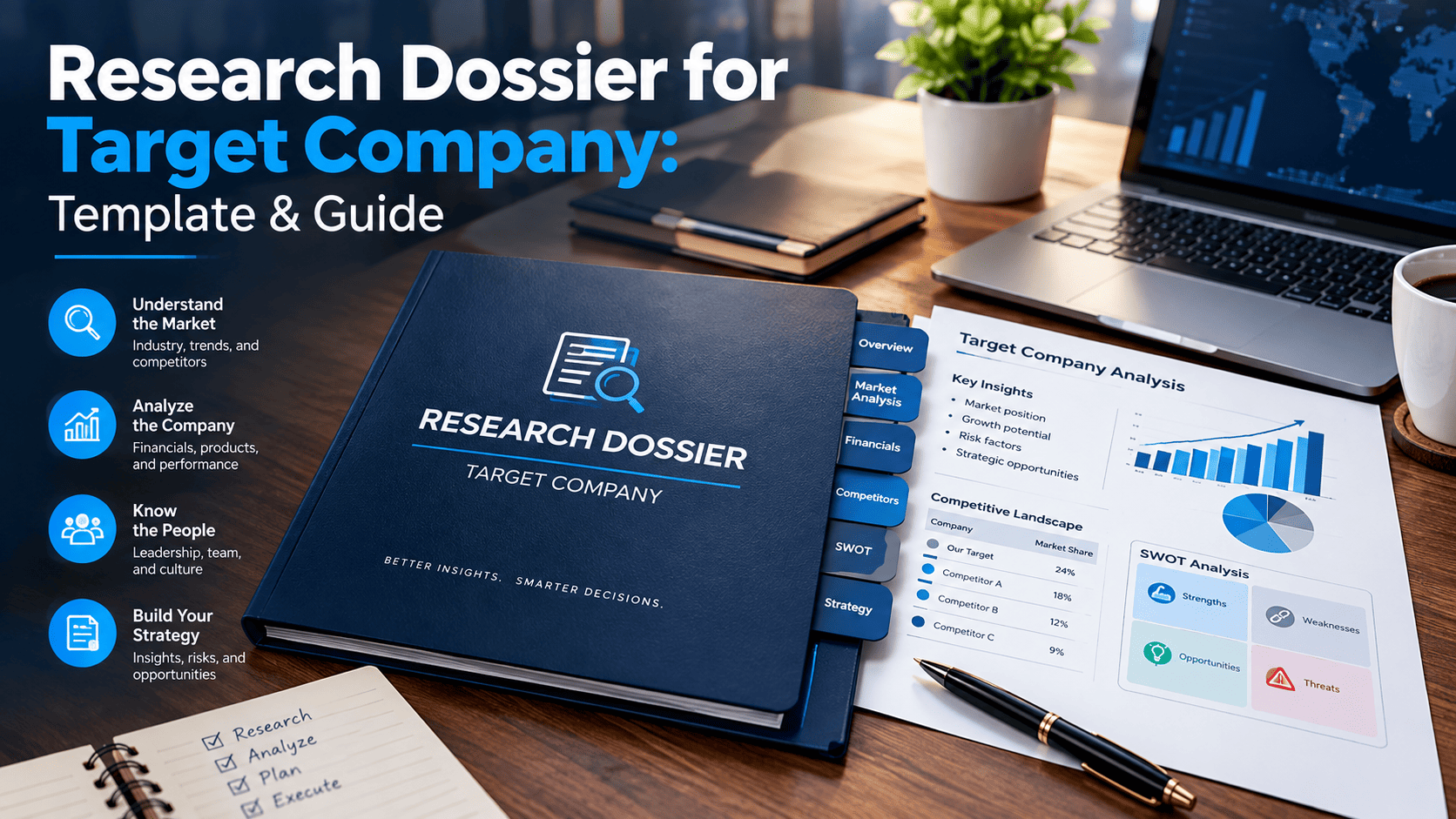
A research dossier for a target company is a structured document that brings together important information about a business and turns that information into useful analysis. It can cover the company’s history, leadership, products and services, customers, business model, competitors, market position, financial information, recent developments, risks, and growth opportunities. Unlike a simple company profile, a dossier is designed to provide deeper insight that can support business decisions, investment research, sales planning, partnerships, competitive analysis, or due diligence.
What Is a Research Dossier?
A research dossier is a comprehensive research document created to understand a particular organization in a structured and organized way. Instead of keeping company information across different websites, reports, articles, databases, and notes, the researcher brings relevant findings together into one document. This makes it easier to understand the company, identify important patterns, compare it with competitors, and reach evidence-based conclusions.
When the research focuses on a target company, the dossier should answer more than basic questions such as what the company is called or what products it sells. A useful dossier should explain how the organization operates, who its customers are, how it generates revenue, where it competes, what advantages it has, and what challenges could affect its performance. The researcher should also distinguish between confirmed facts and personal interpretation so that readers can understand which conclusions are supported by evidence.
The depth of the dossier depends on the reason for creating it. A salesperson researching a potential business customer may focus on the company’s size, decision-makers, products, current challenges, and business priorities. An investor may focus more heavily on financial performance, growth prospects, competitive advantages, and risks. A company conducting competitive research may concentrate on pricing, product positioning, market share, customer segments, and strategic developments.
The main purpose is therefore not to collect the largest possible amount of information. The purpose is to collect the right information, verify it carefully, organize it logically, and explain why it matters.
Research Dossier Template
A well-structured template provides a consistent starting point for company research. It also makes it easier to compare different organizations because the same categories can be researched for each target company.
| Section | Information to Include |
| Company Name | Official business name |
| Website | Official website |
| Industry | Primary industry and sector |
| Headquarters | Main business location |
| Founded | Year established |
| Leadership | Founders, CEO, and key executives |
| Products & Services | Main offerings |
| Target Customers | Primary customer groups |
| Business Model | How the company generates revenue |
| Market Position | Position within the industry |
| Competitors | Direct and indirect competitors |
| Financial Overview | Available financial and business information |
| Recent Developments | Important recent events |
| Strengths | Major competitive advantages |
| Weaknesses | Important limitations |
| Opportunities | Potential growth areas |
| Threats | External risks |
| Key Findings | Main research conclusions |
| Sources | References supporting important findings |
This template can be expanded when the research requires greater detail. For example, a serious investment or due-diligence dossier may need separate sections for ownership, legal matters, financial history, management changes, regulatory exposure, intellectual property, and other specialized areas. For a smaller research project, the same framework can be simplified without losing its basic structure.
What to Include in a Target Company Research Dossier
A strong dossier should begin with a clear company overview. This section establishes the basic identity of the organization and gives readers enough context to understand the analysis that follows. Important details can include the company’s official name, founding year, headquarters, industry, ownership structure, geographic markets, primary business activities, and official website. If the company operates through multiple brands or subsidiaries, that relationship should also be explained when it is relevant to the research objective.
The next major area is the company’s products and services. Rather than simply listing everything the organization offers, explain what its main offerings actually do and which customer problems they are intended to solve. Research should consider the company’s core products, major service categories, pricing approach where available, notable product launches, and the features or benefits that distinguish its offerings. Understanding the product portfolio helps reveal how the company competes and where it may have a stronger or weaker position.
Leadership is another important part of company research. Executives and founders can have a significant influence on strategy, product development, acquisitions, expansion, and overall business direction. A useful dossier should identify important decision-makers and provide relevant information about their professional backgrounds and responsibilities. However, leadership research should remain focused on information that actually helps explain the company’s operations or strategic direction rather than becoming an unnecessary collection of personal details.
The dossier should also examine the company’s target market and customers. Understanding who purchases the company’s products can reveal how the organization positions itself and what kind of demand supports its business. Research may include customer segments, geographic markets, industries served, business-to-business or consumer focus, customer needs, and important market trends. This section becomes especially useful when comparing the target company with competitors that may serve a similar audience in a different way.
Financial and business information should be included whenever reliable data is available. Depending on the company, this might involve revenue, funding, profitability, valuation, growth indicators, operating performance, or other relevant financial measures. Public companies often provide more detailed information through regulatory filings and investor materials, while private companies may disclose considerably less. In either case, the researcher should avoid presenting estimates as confirmed facts and should clearly identify the difference between reported figures, third-party estimates, and analytical conclusions.
Competitor research is equally important because a company cannot be fully understood in isolation. A target company’s strengths often become more meaningful when they are compared with competing organizations. The dossier should identify direct competitors that offer similar products or services as well as indirect competitors that solve the same customer problem in another way. Where useful, the analysis can compare pricing, product features, customer segments, market positioning, distribution, technology, brand strength, and other relevant factors.
Finally, the dossier should cover recent developments. A company that looked attractive six months ago may have changed significantly because of a new product, acquisition, leadership transition, market expansion, financial event, partnership, regulatory change, or other development. Including recent information helps ensure that the dossier reflects the company’s current position rather than simply describing its historical identity.
Filled Research Dossier Example
To understand how the structure works in practice, consider a fictional company called BrightDesk Technologies. Assume that this hypothetical business provides cloud-based customer support and workflow software for small and medium-sized businesses.
BrightDesk Technologies could be described as a business software company founded in 2019 with a subscription-based model. Its main customers are growing businesses that need customer support and workflow tools but may not want the complexity of a large enterprise platform. Its product portfolio could include customer support software, workflow automation, reporting features, and collaboration tools.
The company’s business model would be based primarily on recurring software subscriptions. This model could provide predictable revenue when customers remain subscribed, but it would also make customer retention particularly important. If customers regularly cancel their subscriptions, the company could face pressure to replace lost revenue through new customer acquisition.
From a competitive perspective, BrightDesk could face competition from both large customer-service platforms and smaller specialized software providers. Its potential advantage might be a simpler product designed specifically for smaller businesses. However, its smaller size could also create disadvantages when competing against larger organizations with greater financial resources, broader product portfolios, and stronger brand recognition.
A SWOT analysis of this fictional company might identify its focused customer segment, cloud-based platform, and recurring revenue model as strengths. Potential weaknesses could include lower brand awareness and fewer resources than major competitors. Opportunities could include expansion into new geographic markets, additional automation features, and partnerships with complementary software companies. Threats could include increasing competition, changing customer expectations, cybersecurity concerns, and larger companies entering the same market.
The important point is that a research dossier should connect these individual facts. Instead of simply stating that a company has a subscription model, the analysis should explain how that model affects growth, customer retention, and business risk.
How to Create a Research Dossier: 10-Step Guide
1. Define the Research Objective
The first step is to determine exactly why the company is being researched. Without a clear objective, it is easy to spend time collecting information that has little practical value. A sales professional may want to understand the company’s decision-makers and business challenges, while an investor may need information about financial performance and growth potential. Defining the objective helps determine what information deserves the most attention.
2. Collect Basic Company Information
Once the objective is established, begin with the company’s fundamental information. The official company website is usually a useful starting point because it can provide information about products, services, leadership, locations, and business activities. At this stage, create a basic company profile that can later be expanded with deeper research.
3. Research Products and Services
After understanding the company at a basic level, examine what it actually sells. Research the main products and services, their intended customers, important features, pricing structure where available, and the problems they solve. Product research should also consider whether the company is expanding its portfolio or changing its market positioning.
4. Research the Leadership Team
Next, investigate the executives and founders who influence the company’s strategy. Look at relevant professional experience, responsibilities, leadership changes, and major strategic decisions. The goal is not to create biographies of every employee but to understand the people who have a meaningful role in the organization’s direction.
5. Analyze the Target Market
A company operates within a market, so understanding that market is essential. Research the company’s primary customer groups, geographic reach, industry segments, and major demand drivers. Consider whether the market is expanding, becoming more competitive, changing because of technology, or being affected by economic and regulatory developments.
6. Analyze the Business Model
The business model explains how the company creates value and turns that value into revenue. Determine who pays the company, what they pay for, how often they pay, and what major costs the organization may face. A company might depend on subscriptions, product sales, advertising, licensing, transaction fees, professional services, or enterprise contracts. Understanding this structure can reveal both growth opportunities and potential vulnerabilities.
7. Research Competitors
Competitor research should focus on meaningful comparisons rather than simply producing a long list of names. Identify the company’s strongest direct competitors and then consider indirect alternatives. Compare areas such as products, pricing, customer segments, technology, market positioning, distribution, and competitive advantages. The goal is to understand why customers might choose the target company instead of another option.
8. Review Financial and Recent Business Information
The next stage is to review available financial and corporate information. For public companies, annual reports, regulatory filings, and investor materials may provide substantial detail. For private businesses, reliable financial information may be limited. In both cases, recent developments should be reviewed carefully because acquisitions, funding events, product launches, leadership changes, or market expansion can alter the company’s position.
9. Conduct a SWOT Analysis
Once the main research is complete, organize the findings into strengths, weaknesses, opportunities, and threats. This creates a simple strategic framework that makes complex research easier to understand. The SWOT section should be based on evidence collected during the earlier stages rather than generic statements that could apply to almost any business.
10. Verify, Organize, and Summarize
The final step is quality control. Review the dossier and check whether important claims are supported by credible sources. Remove duplicate information, update outdated facts, clearly label estimates, and separate objective information from interpretation. The dossier should finish with a concise summary of the most important findings and what those findings mean for the research objective.
Best Sources for Company Research and How to Verify Information
The reliability of a research dossier depends heavily on the quality of the information behind it. Search engines can help locate information, but search results should not automatically be treated as evidence. Important claims should be traced back to credible sources whenever possible.
Official company sources are usually the best starting point for basic corporate information. Company websites, investor-relations pages, annual reports, official announcements, product documentation, and press releases can provide first-hand information about products, strategy, leadership, partnerships, and corporate developments.
Regulatory filings can be particularly valuable for public companies because they may contain detailed information about financial performance, business risks, ownership, executive compensation, legal matters, and other material issues. These documents are often more useful for serious research than short summaries published elsewhere.
Reputable news organizations can provide additional context about acquisitions, executive changes, product launches, partnerships, legal developments, and industry events. Industry publications are also useful because they often provide specialized knowledge that general business coverage may not include.
The verification process is just as important as source selection. Major facts should be checked against more than one reliable source when possible. Researchers should pay attention to publication dates because old information can create an inaccurate picture of a company’s current situation. It is also important to distinguish between information directly reported by a source and conclusions that the researcher has drawn from that information.
How to Analyze the Target Company’s Business Model and Competitors
Analyzing a business model means understanding how the company creates value, delivers its products or services, and generates revenue. Start by asking who the company’s customers are and what they are actually paying for. Then consider whether revenue is recurring or one-time, whether customer retention is important, and what major costs could affect profitability.
For example, a subscription software company may benefit from recurring revenue but depend heavily on keeping customers subscribed. A marketplace may depend on attracting both buyers and sellers. A manufacturer may be more exposed to supply-chain costs and physical distribution. These differences matter because they influence the company’s risks and growth opportunities.
Competitor analysis should then place the target company within the wider market. A simple comparison table can help organize the findings:
| Factor | Target Company | Competitor A | Competitor B |
| Main offering | Product/service | Product/service | Product/service |
| Target customers | Segment | Segment | Segment |
| Pricing model | Model | Model | Model |
| Market focus | Market | Market | Market |
| Main advantage | Advantage | Advantage | Advantage |
| Key limitation | Limitation | Limitation | Limitation |
The purpose of this comparison is not simply to decide which company is “best.” Different companies may serve different customer needs. The real objective is to understand the target company’s position, differentiation, vulnerabilities, and potential competitive advantages.
SWOT Analysis for a Target Company
SWOT analysis is one of the most useful ways to turn research findings into a concise strategic assessment. It separates internal characteristics from external conditions, helping readers understand both what the company controls and what it may need to respond to.
Strengths represent internal advantages. These could include strong brand recognition, proprietary technology, loyal customers, experienced leadership, efficient operations, a strong distribution network, or a differentiated product.
Weaknesses represent internal limitations. These may include limited resources, high operating costs, a narrow product portfolio, weak brand recognition, dependence on a small number of customers, or gaps in technology and distribution.
Opportunities are external conditions that could create potential growth. These might include new geographic markets, emerging technologies, new customer segments, strategic partnerships, changing consumer behavior, or expansion into related product categories.
Threats are external factors that could negatively affect the company. Strong competitors, regulatory changes, economic uncertainty, technology disruption, cybersecurity problems, changing customer preferences, and supply-chain challenges can all represent potential threats depending on the industry.
A useful SWOT analysis should be specific to the target company. Generic statements such as “competition is a threat” are less valuable than explaining which competitors create that threat and why.
Research Dossier vs. Company Profile vs. Competitive Analysis
These three forms of research are related, but they serve different purposes. A company profile is usually a concise overview of an organization and focuses on basic facts. Competitive analysis concentrates on comparing one company against its alternatives. A research dossier is broader and can combine company information, market research, competitive analysis, risks, financial information, and strategic findings.
| Feature | Research Dossier | Company Profile | Competitive Analysis |
| Company background | Detailed | Detailed | Limited |
| Leadership | Detailed | Usually included | Sometimes |
| Products/services | Detailed | Included | Comparative |
| Business model | Yes | Sometimes | Often |
| Competitors | Detailed | Limited | Central focus |
| Market analysis | Detailed | Basic | Detailed |
| Risks | Yes | Limited | Often |
| SWOT | Often | Sometimes | Often |
| Strategic insights | Strong | Limited | Strong |
| Main purpose | Comprehensive research | Company overview | Competitive comparison |
Understanding this difference helps researchers select the right format. If the objective is simply to introduce a business, a company profile may be enough. If the goal is to understand the entire competitive environment, a competitive analysis may be more appropriate. When the research needs a broader picture that combines several types of information, a research dossier is generally more suitable.
Common Research Dossier Mistakes to Avoid
One of the most common mistakes is relying on outdated information. Companies change quickly, particularly in industries affected by technology, investment, regulation, and changing customer behavior. Leadership teams can change, products can be discontinued, businesses can be acquired, and strategies can shift. For that reason, researchers should always check when important information was published.
Another mistake is relying too heavily on a single source. Even a credible source may provide only one part of the story. Important claims should be compared with additional reliable sources when possible. This is especially important when researching financial information, market claims, controversial developments, or strategic decisions.
A dossier can also become weak when it contains many facts but little analysis. Simply stating that a company has a certain product, competitor, or business model does not explain why that information matters. Strong research connects facts together and shows what they reveal about the company’s position.
Researchers should also avoid presenting assumptions as facts. Estimates, predictions, interpretations, and confirmed information are not the same thing. Clearly labeling them makes the dossier more trustworthy and prevents readers from misunderstanding the evidence.
Ignoring competitors is another major weakness. A company may appear strong when viewed by itself but face significant challenges when compared with alternatives. Similarly, focusing only on opportunities while ignoring risks can create a biased assessment.
Finally, failing to record sources makes the dossier difficult to maintain. If readers cannot determine where an important fact came from, they may have difficulty verifying it. Keeping source information during the research process makes future updates much easier.
Final Research Dossier Checklist
Before publishing or using the dossier, review the entire document and confirm that the research objective is clear, the company background is complete, and the products, services, customers, leadership, business model, market position, and competitors have been properly investigated. Financial information should be verified where available, while recent developments should be checked for current relevance.
The dossier should also contain a balanced assessment of strengths, weaknesses, opportunities, and threats. Important claims should have credible supporting sources, and outdated information should either be removed or clearly identified. The final section should summarize the most important findings instead of simply repeating information already presented.
A strong final review should answer one central question: Does this dossier give the reader enough reliable information to make a better-informed decision about the target company? If the answer is yes, the research has achieved its main purpose.
Conclusion
A research dossier for a target company is much more valuable than a simple collection of company facts. When properly prepared, it provides a structured view of an organization’s history, products, customers, leadership, business model, market position, competitors, financial situation, risks, and opportunities.
The strongest dossiers are built around a clear research objective and use reliable sources throughout the process. They do not simply collect information; they organize that information and explain its significance. This makes the final document useful for sales teams, investors, business researchers, strategists, analysts, and professionals conducting due diligence.
Using a consistent template can make the process faster and more reliable. Start with the company’s basic information, move into products and markets, examine the business model and competitive landscape, verify important facts, complete a SWOT analysis, and finish with clear key findings. With this approach, a research dossier becomes a practical decision-making tool rather than just another company report.
FAQs
What is a research dossier for a target company?
A research dossier is a structured document that collects, verifies, and analyzes important information about a specific company. It can include company history, products, leadership, customers, business model, competitors, financial information, risks, opportunities, and recent developments.
What should a company research dossier include?
A comprehensive dossier should normally include the company overview, products and services, target market, leadership, business model, competitors, financial information where available, recent developments, SWOT analysis, risks, opportunities, sources, and key findings.
How do you research a target company?
Begin by defining the purpose of the research. Then collect basic company information, study products and customers, research leadership, analyze the business model and market, identify competitors, review financial and recent business information, verify important claims, and summarize the findings.
Where can you find reliable company information?
Reliable information can often be found through official company websites, annual reports, regulatory filings, investor-relations materials, official announcements, reputable news organizations, industry publications, and credible business databases. Important information should be cross-checked whenever possible.
[…] Business Operations: The Complete Guide to Processes, Management & Success Adstotally.com Explained: Website Overview, Benefits & Legitimacy Transjoaimo: Complete Company Profile, Services, Registration & Logistics Guide EasyJet Flight U2238 Emergency Landing Newcastle: Full Incident Explained Research Dossier for Target Company: Template & Guide […]