

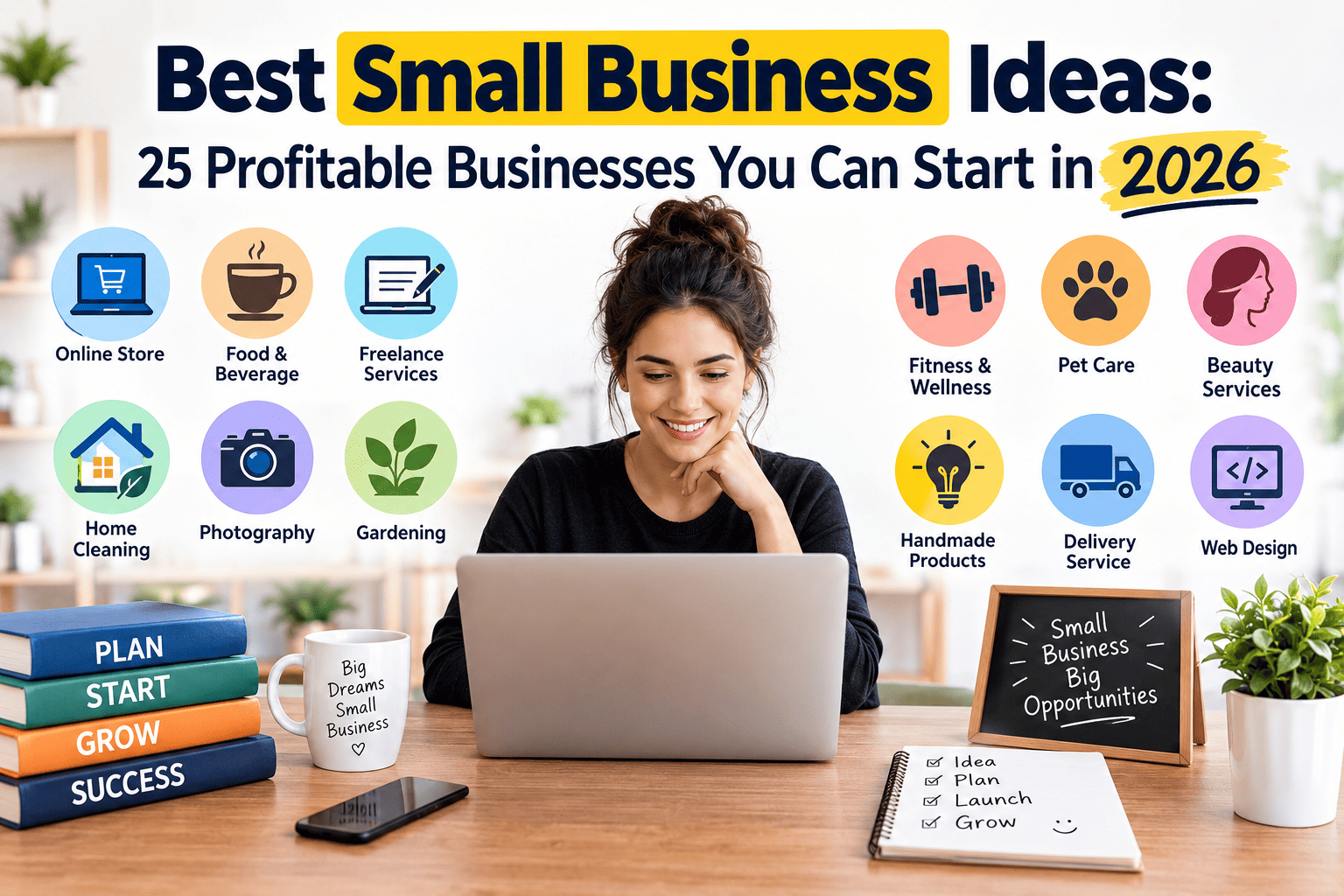
Starting a small business in 2026 can be an exciting way to turn a useful skill, creative idea, or market opportunity into a source of income. You do not always need a large investment, an office, or a big team to get started. Many successful small businesses can begin from home, online, or as a part-time project and gradually grow as customers and revenue increase.
The key is choosing an idea that matches your skills, available budget, location, target customers, and long-term goals. Some businesses require very little equipment, while others need inventory, specialized knowledge, or local permits. Before investing money, it is important to research demand, competitors, startup expenses, pricing, and the type of customers you want to serve.
This guide explores 25 of the best small business ideas for 2026, including online businesses, service-based businesses, home-based opportunities, creative ventures, and local businesses. Whether you are a beginner looking for your first business or someone searching for a new side income opportunity, these ideas can help you identify a direction worth researching.
What Makes a Small Business Idea Worth Starting?
A promising business usuallybest small business ideas solves a specific problem or fulfills a clear customer need. Instead of choosing an idea simply because it is popular, consider whether people are actually willing to pay for the product or service. A smaller market with strong customer demand can sometimes be more useful than a huge market with intense competition.
Startup cost is another important consideration. A business that can be launched with existing equipment and skills may allow you to test your concept without taking on significant financial risk. You should also consider recurring expenses such as software subscriptions, advertising, supplies, transportation, insurance, website costs, and inventory.
Your own skills matter as well. If you already understand graphic design, writing, cooking, technology, education, photography, or another field, building a business around that knowledge can make the learning process easier. The strongest business ideas often combine something you can do well with something customers genuinely need.
1. Digital Marketing Agency
Businesses of all sizes need help reaching customers online. A small digital marketing agency can provide services such as social media management, search engine optimization, email marketing, content strategy, and online advertising.
You can begin by focusing on one service rather than trying to offer everything at once. For example, a beginner might specialize in social media management for local restaurants, real estate professionals, or small retailers. As the client base grows, additional services can be introduced.
2. Freelance Writing Business
If you have strong writing skills, freelance writing can become a flexible service business. Companies, websites, publishers, and entrepreneurs often need blog posts, website copy, product descriptions, newsletters, and other written content.
A professional portfolio can help demonstrate your ability to potential clients. Instead of competing solely on low prices, developing expertise in a particular subject can help you build a recognizable niche and attract customers looking for specialized knowledge.
3. Online Tutoring
Online tutoring is another business opportunity for people with knowledge in academic subjects, languages, music, technology, or other educational areas. Lessons can be delivered through video calls and digital learning platforms.
The business can start with one subject and a small number of students. Over time, you can create group classes, study resources, recorded lessons, or structured courses to expand the business beyond individual tutoring sessions.
4. Virtual Assistant Services
Small companies and independent professionals often have administrative tasks that consume valuable time. A virtual assistant can help with scheduling, email organization, research, data entry, customer communication, document preparation, and other remote tasks.
This can be particularly attractive for people who are organized and comfortable working with online tools. You can begin independently and eventually build a small virtual assistant team if demand increases.
5. Social Media Management
Social media management focuses on helping businesses maintain a consistent presence on platforms such as Instagram, Facebook, TikTok, LinkedIn, and other relevant networks.
A social media manager may create content calendars, write captions, schedule posts, monitor engagement, and prepare performance reports. Specializing in a particular industry can make it easier to understand the audience and create relevant content.
6. Home-Based Food Business
If you enjoy cooking or baking, a home-based food business can provide a way to turn that skill into a commercial opportunity. Depending on local regulations, possible products include baked goods, snacks, specialty foods, desserts, meal preparation, or catering.
Food businesses require careful attention to hygiene, packaging, pricing, ingredient costs, and applicable local rules. Testing a small menu before expanding can help identify which products customers actually want.
7. Cleaning Services
Residential and commercial cleaning services remain straightforward service businesses because customers regularly need clean and maintained spaces.
You can start independently with basic equipment and gradually add customers in a defined service area. Specialized services such as move-out cleaning, office cleaning, or deep cleaning can provide additional opportunities depending on local demand.
8. Pet Care Business
Pet owners may need help with walking, sitting, feeding, grooming coordination, or other routine pet-care responsibilities. A small pet-care business can begin with services that require limited equipment.
Trust is especially important in this type of business. Clear communication, reliable scheduling, responsible handling, and positive customer reviews can help build a strong local reputation.
9. Photography Business
Photography can become a small business for people with photography skills and suitable equipment. Potential niches include portraits, family events, products, real estate, food, social media content, and small business branding.
Choosing a specific niche can help you create a focused portfolio. For example, a photographer specializing in product photography can build examples specifically designed to demonstrate how products can be presented professionally.
10. Graphic Design Services
Graphic designers can provide logos, social media graphics, presentations, marketing materials, packaging concepts, and other visual assets.
A freelance graphic design business can often be operated remotely. Building a portfolio around a particular type of client, such as restaurants, startups, online stores, or local businesses, can make marketing more targeted.
11. E-Commerce Store
An e-commerce store allows you to sell physical or digital products through an online storefront. Products can range from handmade goods and customized items to niche accessories and downloadable resources.
Successful e-commerce businesses generally focus on a clear customer group rather than attempting to sell everything. Product research, pricing, customer service, shipping, returns, and marketing all play important roles.
12. Print-on-Demand Business
Print-on-demand allows entrepreneurs to sell designs printed on products such as shirts, mugs, posters, notebooks, and other merchandise without maintaining a large inventory themselves.
The biggest challenge is creating designs that appeal to a specific audience. A focused niche, consistent branding, quality product descriptions, and effective promotion can help distinguish a store from thousands of competing products.
13. Website Development
Businesses need websites for presenting their services, selling products, generating leads, and establishing an online presence. If you understand web development or website-building platforms, you can offer website creation services.
A beginner can start with relatively simple business websites before moving into more advanced projects. Ongoing maintenance, updates, security, and content management can also become recurring services.
14. Mobile Car Detailing
Mobile car detailing brings cleaning and detailing services directly to customers. This can be convenient for people who do not want to take their vehicles to a traditional detailing shop.
Startup requirements vary depending on the services offered and equipment used. A business can begin with a limited service menu and expand as customer demand and revenue increase.
15. Home Repair and Handyman Services
People frequently need help with minor repairs, maintenance, assembly, painting, installation, and other household tasks. A handyman business can serve homeowners, landlords, and property managers.
The services you can legally provide may depend on your location and the type of work involved. Always check applicable licensing, safety, insurance, and permit requirements before accepting specialized jobs.
16. Personal Fitness Coaching
Fitness professionals can offer individualized coaching, group sessions, online programs, or general fitness education depending on their qualifications and local requirements.
A strong business model focuses on helping a defined customer group achieve realistic goals. Building trust through professional communication, useful educational content, and consistent service can be important for attracting long-term clients.
17. Beauty and Personal Care Services
Beauty-related services can include hairstyling, makeup, nail services, skincare services, or other specialized offerings where legally permitted.
Some services require professional qualifications, licenses, or specific health and safety standards. A home-based setup, studio, or mobile service model can be considered depending on local regulations and customer preferences.
18. Translation Services
People with strong language skills can offer translation, localization, proofreading, or interpretation-related services. Businesses may need help adapting documents, websites, product information, or marketing materials for different audiences.
Specializing in a particular industry can be valuable because technical, legal, medical, and business content may require knowledge beyond basic language fluency.
19. Online Course Creation
If you have expertise in a useful subject, you can create an online course around that knowledge. Topics might include software skills, languages, professional skills, crafts, photography, business fundamentals, or other educational subjects.
Creating a course requires more work upfront than one-to-one tutoring, but digital educational products can potentially be sold repeatedly. Quality lessons, clear organization, practical examples, and ongoing updates can improve the customer experience.
20. Consulting Services
Consulting can be a suitable small business for professionals who have substantial experience in a particular field. Areas can include marketing, operations, technology, finance education, human resources, business strategy, or other specialized subjects.
A consultant generally needs to demonstrate expertise and communicate clearly with clients. Building a reputation through useful content, networking, referrals, and successful projects can support long-term growth.
21. Home Organization Services
Professional home organization helps customers create more functional and manageable living spaces. Services may include decluttering, storage planning, room organization, and practical setup recommendations.
This business can be started on a local basis with relatively simple equipment. Before-and-after examples, clear service packages, and customer testimonials can help explain the value of the service.
22. Landscaping and Gardening Services
Gardening and landscaping services can include lawn maintenance, planting, garden cleanup, trimming, seasonal preparation, and other outdoor work.
A local service area can make scheduling more efficient. As the business grows, additional workers and specialized equipment can be introduced. Seasonal demand should be considered when planning pricing and cash flow.
23. Event Planning
Event planners help individuals and organizations coordinate celebrations, meetings, parties, weddings, and other occasions. Services can range from complete event coordination to specific planning tasks.
Organization and communication are essential because event planning involves multiple vendors, deadlines, budgets, and customer expectations. Starting with smaller events can provide useful experience before taking on larger projects.
24. Reselling Business
Reselling involves purchasing products at an attractive price and selling them to customers through online marketplaces, social platforms, or other sales channels.
Success depends heavily on product selection, sourcing, pricing, demand research, and accurate profit calculations. Before buying inventory, calculate the complete cost, including shipping, platform fees, packaging, returns, and other expenses.
25. Content Creation Business
Content creation can include blogging, video production, educational content, photography, podcasts, newsletters, or social media publishing. Revenue can potentially come from advertising, sponsorships, subscriptions, affiliate relationships, digital products, or services.
Building an audience usually takes time, so consistency and useful content are more important than expecting immediate results. Choosing a clear topic or audience can make it easier to create a recognizable content brand.
How to Choose the Right Small Business Idea
With so many possibilities, the best approach is to compare an idea against your personal resources and the market you want to serve. Start by identifying your strongest skills and asking which problems those skills can solve for other people.
Your available budget should also influence your decision. A service business may require less upfront capital than an inventory-heavy business. If your budget is limited, consider starting with an idea that allows you to sell your time or expertise before investing heavily in equipment or stock.
Market research is equally important. Search for competitors, examine customer reviews, study pricing, and talk to potential customers. Pay attention to complaints because they can reveal problems that an existing business is not solving well.
Low-Cost Small Business Ideas
Some of the ideas in this guide can be started with relatively limited upfront investment. Freelancing, tutoring, virtual assistance, writing, translation, consulting, social media management, and certain forms of content creation may require little more than a computer, internet connection, relevant skills, and a way to reach customers.
However, low startup cost does not automatically mean easy profitability. You still need to spend time finding customers, delivering quality work, managing expenses, and building a reputation. A low-cost business becomes more attractive when there is clear demand and a realistic path to earning more than your operating costs.
Online vs. Local Small Businesses
Online businesses can reach customers across wider geographic areas and may offer flexible working arrangements. Freelancing, online tutoring, digital products, e-commerce, consulting, and content creation are examples of businesses that can operate largely online.
Local businesses, meanwhile, can benefit from strong community relationships and repeat customers. Cleaning, landscaping, pet care, car detailing, home services, photography, and food-related businesses may work well in specific local markets.
Neither model is automatically suitable for everyone. Your decision should depend on the type of customer you want to serve, your skills, competition, operating costs, and the amount of flexibility you need.
How to Start a Small Business in 2026
Starting does not require building a huge operation immediately. Begin by defining your customer and the specific problem your business will solve. Then create a simple description of your product or service and determine how much customers would realistically pay.
Next, research competitors and calculate your expected startup and monthly expenses. Include costs that are easy to overlook, such as transportation, software, marketing, packaging, payment processing, maintenance, and taxes.
Once the numbers make sense, test your idea with a small group of potential customers. Their feedback can help you improve your offer before you invest more money. Depending on your location and business type, you may also need to register the business, obtain licenses or permits, arrange insurance, and understand applicable tax requirements.
Common Mistakes New Entrepreneurs Should Avoid
One common mistake is spending too much money before proving that customers want the product or service. A polished website or expensive equipment cannot compensate for weak demand.
Another mistake is trying to serve everyone. A clearly defined audience can make your marketing, pricing, messaging, and customer service much easier to manage.
It is also important to separate personal and business finances where appropriate, track revenue and expenses, understand your pricing, and maintain accurate records. Professional advice may be useful when dealing with taxes, contracts, licensing, or other specialized requirements.
Final Thoughts
The best small business ideas are not necessarily the ones that look the most exciting on social media. A strong opportunity usually combines genuine customer demand with your skills, available resources, and ability to deliver consistent value.
Whether you choose freelancing, digital marketing, tutoring, cleaning, e-commerce, consulting, food services, or another opportunity, start with research rather than a large financial commitment. Test your idea, listen to customers, track your numbers, and improve your offer as you learn.
A small business can begin with one customer and one service. The important step is creating a practical plan, understanding your market, and building the business gradually instead of expecting instant success.
Frequently Asked Questions
What is the best small business to start in 2026?
There is no single business that is right for everyone. The most suitable option depends on your skills, budget, location, customer demand, and available time. Service businesses can be a practical starting point because some require less upfront inventory.
What are the best low-cost small business ideas?
Freelance writing, virtual assistance, online tutoring, translation, social media management, consulting, and some types of content creation can often be started with relatively low initial expenses.
Can I start a small business from home?
Yes. Depending on local laws and the type of business, many businesses can operate from home, including freelancing, tutoring, online consulting, digital services, content creation, certain food businesses, and online stores.
How much money do I need to start a small business?
The required amount varies significantly. A service business may require relatively little initial investment, while businesses involving inventory, specialized equipment, premises, or employees can require substantially more. Create a detailed startup budget before investing.
How do I know whether a business idea is profitable?
Research customer demand, competitor pricing, startup costs, ongoing expenses, and potential sales volume. Calculate your expected revenue and costs, then test the idea with real customers before making a major investment.
What is the easiest small business for a beginner?
Businesses based on skills you already possess can be easier to understand and launch. Freelancing, tutoring, virtual assistance, writing, social media services, and other specialized services can be possible starting points for beginners.
Should I start a business full-time or as a side business?
Starting part-time can allow you to test demand and learn how the business works before making a larger commitment. The right approach depends on your financial situation, responsibilities, available time, and business model.