

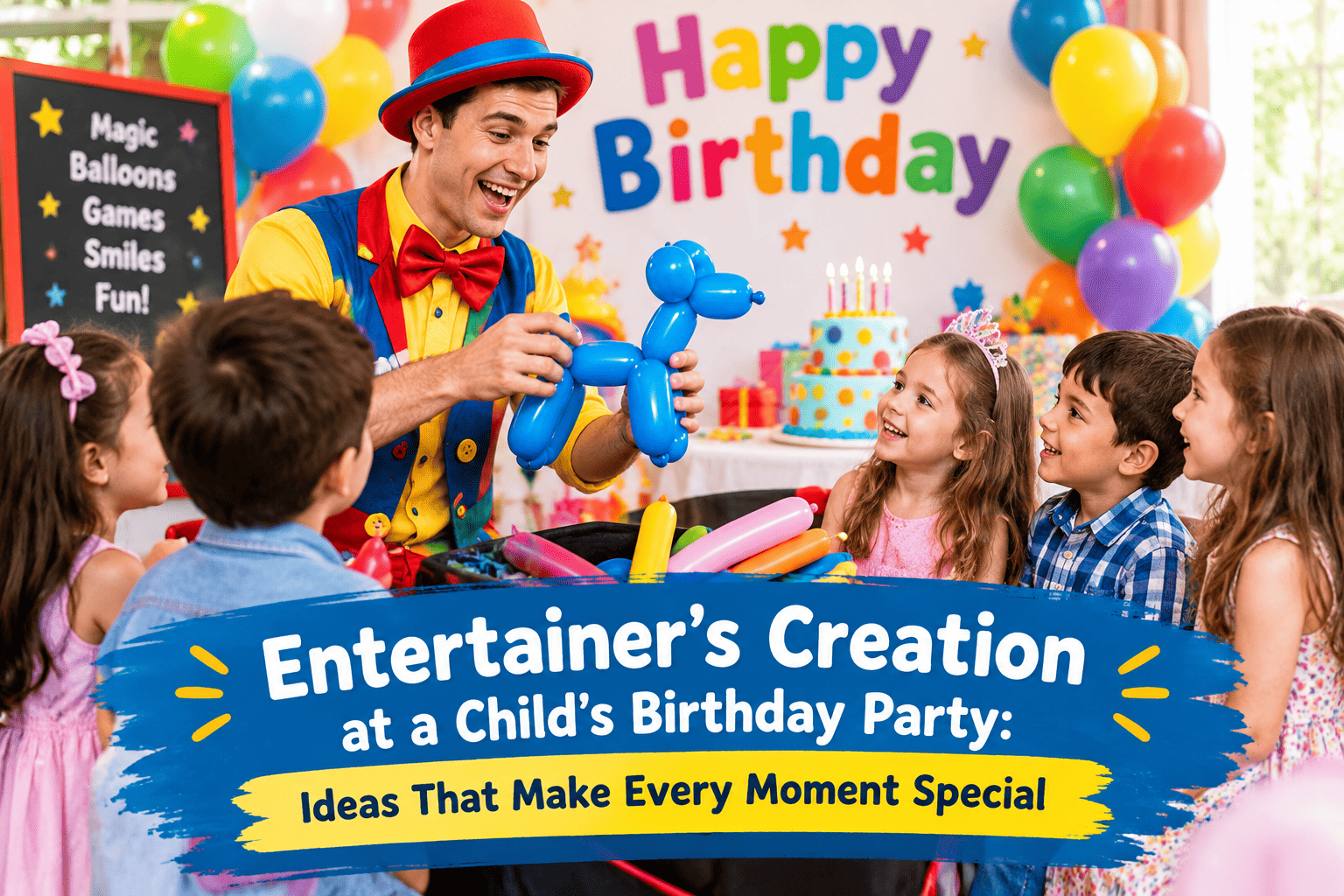
An entertainer’s creation at a child’s birthday party is a performance, activity, or personalised experience designed to make the celebration enjoyable and memorable. Popular options include magic shows, puppet performances, storytelling, music, dancing, creative crafts, and themed adventures. The best entertainment reflects the birthday child’s interests, suits the guests’ ages, and provides opportunities for everyone to participate comfortably.
Introduction
A child’s birthday is an opportunity to celebrate another year of growth, friendship, and happiness. Although decorations, presents, and birthday cake are traditional parts of the occasion, entertainment often becomes one of the most memorable elements. A creative performance can bring children together, encourage their imagination, and turn an ordinary gathering into a special experience.
An entertainer’s creation at a child’s birthday party can involve much more than a magician or a costumed character. It may include an interactive story, a themed treasure hunt, a music session, a creative workshop, or a series of games designed around the birthday child’s favourite interests. The purpose is to give children something enjoyable to experience rather than simply filling the party schedule.
Planning successful entertainment requires an understanding of the guests, the available space, and the type of atmosphere the family wants to create. Some children enjoy energetic activities, while others prefer quieter experiences involving art, stories, or imaginative play. When entertainment reflects these differences, a birthday celebration can feel more personal, inclusive, and rewarding.
What Is an Entertainer’s Creation at a Child’s Birthday Party?
The term describes a specially planned entertainment experience created to make a child’s birthday celebration engaging. It may be delivered by a professional entertainer, an experienced party host, a creative activity leader, or a family member who has prepared an original programme.
A typical experience might combine an opening performance, interactive games, a short storytelling session, and a themed activity. For example, a space-themed party could include an imaginary astronaut mission, planet-related puzzles, and a creative activity in which children design their own spacecraft using paper and other suitable materials.
The defining feature is personalisation. Instead of repeating the same activities at every event, the organiser considers the child’s age, personality, interests, and preferences. This approach can make even a relatively simple celebration feel distinctive without requiring expensive equipment or elaborate arrangements.
Best Entertainment Ideas for a Child’s Birthday Party
1. Interactive Magic Shows
Magic shows are popular because they combine surprise, curiosity, humour, and audience participation. An entertainer might perform simple illusions, use colourful props, or invite children to assist with a suitable trick. These moments give guests something to discuss and remember after the performance ends.
The presentation should match the children’s ages and comfort levels. Younger audiences may respond well to visual surprises and playful characters, while older children may enjoy predicting what happens next. A good performer keeps the atmosphere friendly and gives children the option to participate without making anyone feel embarrassed.
2. Puppet Shows and Creative Storytelling
Puppet shows offer a gentle form of entertainment that can appeal to children who enjoy stories and imaginary characters. A simple performance might follow a character who loses a special object, discovers a mysterious place, or learns the importance of kindness and cooperation.
Storytelling can become more engaging when children help shape the plot. The host might ask them to suggest a character’s name, choose between two possible adventures, or make a sound whenever a familiar event occurs. These small interactions encourage participation while keeping the activity easy to follow.
3. Music, Dancing, and Movement Games
Music can create an energetic atmosphere and help guests become comfortable with one another. Musical statues, action songs, simple dance challenges, and age-appropriate karaoke can provide entertainment without requiring complicated preparation.
A successful music session should include variety. Alternating energetic songs with quieter moments helps children manage their excitement and gives them opportunities to rest. Children who do not wish to dance can watch, choose a song, or take part in another activity instead.
4. Creative Arts and Crafts
Arts and crafts give children the chance to produce something they can take home. Suitable activities might include decorating paper crowns, creating birthday cards, drawing favourite characters, making simple collages, or designing colourful bookmarks.
Preparation makes this activity easier to manage. Organisers should arrange materials before guests arrive, provide enough supplies, and demonstrate the finished project. Washable colours, age-appropriate scissors, and easily cleaned work surfaces can make the experience more practical.
5. Treasure Hunts and Adventure Games
A treasure hunt transforms the party into a shared adventure. Children follow clues, search for hidden objects, solve simple puzzles, or complete small challenges before reaching a final destination. The activity can be adapted to almost any theme.
For younger children, picture clues and obvious hiding places are usually easier to understand. Older guests may enjoy riddles and more complicated puzzles. The organiser should make sure that every child has a meaningful opportunity to participate, rather than allowing only the fastest players to complete the challenges.
6. Science and Discovery Activities
Science-themed entertainment introduces children to observation, experimentation, and curiosity. A suitable programme might include demonstrations involving colour mixing, floating objects, magnets, or other simple scientific concepts.
The activity should be educational without becoming a formal classroom lesson. An entertainer can ask children what they think will happen, demonstrate the result, and explain the observation in accessible language. All materials and demonstrations must be appropriate for the children’s ages and supervised by a responsible adult.
Choosing Entertainment According to Children’s Ages
Age is an important factor when selecting birthday entertainment because children have different interests, attention spans, and abilities at different developmental stages.
Entertainment for Toddlers
Toddlers often enjoy familiar songs, bubbles, simple sensory activities, puppets, and gentle movement games. They may prefer exploring at their own pace rather than following a structured performance.
For this age group, short activities and a calm environment are especially helpful. Parents should consider nap schedules, safe play areas, and close supervision. Large crowds and complicated games may make the celebration unnecessarily overwhelming.
Entertainment for Preschool Children
Children around three to five years old often enjoy pretend play, storytelling, simple treasure hunts, music, and colourful performances. Their growing imagination makes it possible to build a party around a character, animal, or adventure.
Activities should be easy to understand and flexible enough to accommodate different confidence levels. Clear instructions, simple rules, and opportunities to take turns can help the group enjoy the experience together.
Entertainment for School-Aged Children
Children around six to ten years old may enjoy magic shows, themed challenges, creative workshops, team puzzles, and organised games. Many are also ready to contribute their own ideas and help choose the party theme.
The organiser can provide a greater degree of choice at this stage. For instance, guests might choose between a craft station, a puzzle challenge, or a music activity. Offering options makes the party feel less repetitive and allows different interests to be accommodated.
Entertainment for Older Children
Older children may prefer activities that feel creative, social, and less childish. Depending on their interests, suitable options include karaoke, photography challenges, collaborative art, themed quizzes, cooking activities with appropriate supervision, and team-based puzzles.
Consulting the birthday child before making arrangements is particularly valuable. Older children often have clear preferences about music, themes, games, and how they want to celebrate with friends.
Creative Themes That Make Entertainment Special
Fantasy and Storybook Adventures
A fantasy theme can turn the party into an imaginary kingdom, enchanted forest, or magical quest. The entertainer might introduce a fictional problem that guests solve through puzzles, teamwork, and creative decisions.
Simple props and imaginative storytelling can support the theme without requiring expensive decorations. The key is to give children opportunities to influence the experience and make their own creative contributions.
Dinosaur and Animal Adventures
Children who love animals or dinosaurs may enjoy a party built around discovery and exploration. Activities could include identifying animal tracks, matching pictures, solving dinosaur-themed puzzles, or creating paper animal masks.
The theme can also encourage learning. An adult leading the activities can introduce age-appropriate facts about animal habitats, fossils, and the natural world while keeping the main focus on enjoyment.
Space Exploration
A space-themed party can invite children to imagine travelling between planets, exploring distant worlds, and completing astronaut challenges. Paper rockets, planet-matching games, and imaginative missions can make the experience interactive.
The organiser can combine creative activities with simple science explanations. This makes the theme suitable for children who enjoy both imaginative play and learning new things.
Art and Colour Celebrations
An art-focused party allows children to experiment with colours, shapes, and different materials. They might create individual pictures or contribute to a shared artwork that becomes a keepsake for the birthday child.
This format is particularly useful when guests have different activity preferences. Children can work independently, collaborate with friends, or move between several creative stations.
How to Plan a Successful Entertainment Schedule
A well-planned schedule gives the celebration structure without making it feel overly organised. Begin with a relaxed arrival period when guests can greet one another, explore the party space, and choose a simple activity.
Once most guests have arrived, introduce the main performance or group game. The central activity should be scheduled when children are settled and ready to participate. Afterward, provide time for free play, crafts, or another quieter option.
Food and cake can be planned around the family’s preferences and the event’s overall timing. Avoid scheduling every minute, because children often need time to socialise, explore, or return to an activity they particularly enjoy.
The appropriate duration depends on the age group and setting. Young children’s parties often work best when kept relatively short, while older children may enjoy a longer celebration. A flexible plan is generally more useful than a rigid timetable.
What Makes a Good Children’s Party Entertainer?
A good entertainer combines creativity with communication, preparation, and an understanding of children’s needs.
Communication Skills
The entertainer should explain activities clearly, use age-appropriate language, and respond patiently to questions. Simple instructions help children understand what to do and reduce confusion during group activities.
Adaptability
Children may respond differently from what the organiser expects. Some might become excited immediately, while others need time to observe. A flexible entertainer can change the pace, simplify a game, or offer a quieter alternative when necessary.
Audience Participation
Interactive entertainment gives children opportunities to contribute instead of remaining passive spectators. However, participation should always be optional. A child who prefers watching should not be pressured to perform, dance, or speak in front of everyone.
Preparation and Reliability
Before the event, the entertainer should understand the schedule, venue, number of guests, equipment requirements, and any relevant accessibility or safety considerations. Parents should confirm what is included in the service and whether additional equipment or assistance is needed.
Originality
Personalised stories, imaginative challenges, and activities linked to the birthday child’s interests can distinguish one performance from another. Originality does not necessarily require elaborate props; thoughtful details and engaging presentation can be equally effective.
Safety and Inclusion During Birthday Entertainment
Safety should be considered before choosing activities or arranging the party space. Organisers should remove foreseeable hazards, keep walkways clear, secure equipment, and ensure children receive suitable supervision.
Materials should be selected according to the ages of the guests. Small objects can present choking hazards for young children, while craft supplies should be used according to their instructions. If the party includes physical games, the playing area should provide sufficient room and a suitable surface.
Sensory needs also deserve attention. Loud music, flashing lights, crowded spaces, or unexpected performances may be uncomfortable for some children. Providing a quieter area and allowing guests to take breaks can help everyone feel more welcome.
Parents should also consider allergies, dietary needs, accessibility, and the availability of responsible adults. A successful celebration is not one in which every child participates in exactly the same way, but one in which each guest has a reasonable opportunity to enjoy the event.
Budget-Friendly Birthday Entertainment Ideas
A memorable birthday party does not have to involve expensive performers or complicated equipment. Many activities can be organised using everyday materials and a little preparation.
A family member can host a storytelling session, organise a picture-based treasure hunt, or lead a music game. A craft table with paper, crayons, and suitable decorations can keep interested children engaged while providing a small souvenir of the event.
When comparing professional entertainers, consider the entire service rather than the advertised price alone. Ask about performance length, equipment, travel costs, preparation, and the number of children included in the package.
It is also useful to consider the time required to organise activities independently. A professional entertainer may provide equipment and a structured programme, while a family-led celebration offers greater flexibility. Either approach can work well when it matches the family’s budget and expectations.
Common Mistakes to Avoid
One frequent mistake is choosing entertainment based entirely on what adults find impressive. Children may not enjoy an elaborate performance if it does not match their interests or developmental stage. Asking the birthday child about favourite activities can help prevent this problem.
Another mistake is scheduling too many activities. A continuous programme can leave children tired and give them little time to play freely. A better approach is to select a few main activities and keep optional alternatives available.
Organisers should also avoid excessive competition. Games that repeatedly reward only the fastest or most confident participants may leave other guests feeling excluded. Cooperative challenges and activities with several ways to participate can create a friendlier atmosphere.
Finally, parents should avoid leaving arrangements until the last minute. Confirming the schedule, preparing supplies, checking the venue, and arranging supervision in advance can reduce stress and help the celebration run smoothly.
Conclusion
An entertainer’s creation at a child’s birthday party can transform a simple gathering into an engaging celebration filled with imagination, laughter, creativity, and shared experiences. From interactive magic shows and puppet performances to treasure hunts, science activities, and arts and crafts, there are many ways to make the occasion memorable.
The most effective entertainment is not necessarily the most expensive or elaborate. It is the experience that reflects the birthday child’s interests, suits the guests’ ages, and allows everyone to participate comfortably. With thoughtful preparation, flexible activities, and appropriate supervision, parents can create a birthday celebration that feels personal and enjoyable.
Frequently Asked Questions
1. What does an entertainer’s creation at a child’s birthday party mean?
It refers to a performance, activity, or personalised entertainment experience designed for a child’s birthday celebration. Examples include magic shows, storytelling, puppet performances, music, creative workshops, and themed games.
2. What is the best entertainment for a children’s birthday party?
The best option depends on the guests’ ages, interests, and personalities. Younger children may enjoy puppets, bubbles, and simple songs, while older children might prefer treasure hunts, creative workshops, science demonstrations, or music-based activities.
3. Is hiring a professional birthday entertainer worth it?
A professional can provide experience, equipment, and a structured performance, which may reduce the organiser’s workload. However, family-led activities can also create memorable experiences. The right decision depends on the budget, venue, available preparation time, and desired entertainment style.
4. How long should birthday entertainment last?
There is no universal duration. Younger children often benefit from shorter activities and breaks, while school-aged children may enjoy longer sessions. The organiser should consider the children’s attention spans, energy levels, and the overall party schedule.
5. How can I make birthday entertainment more creative?
Build activities around the birthday child’s favourite interests, introduce an imaginative story, offer interactive challenges, and provide opportunities for children to create something. Small personalised details can make a party feel special without requiring a large budget.
6. How can I keep all children involved?
Offer a mixture of activities, explain the rules clearly, encourage teamwork, and allow children to choose how they participate. Avoid forcing shy guests to perform and provide quieter alternatives for children who need a break.
7. Can I organise entertaining birthday activities at home?
Yes. Home celebrations can include storytelling, music games, craft stations, simple treasure hunts, puppet shows, and themed challenges. Choose activities that suit the available space, prepare the materials beforehand, and arrange appropriate adult supervision.