

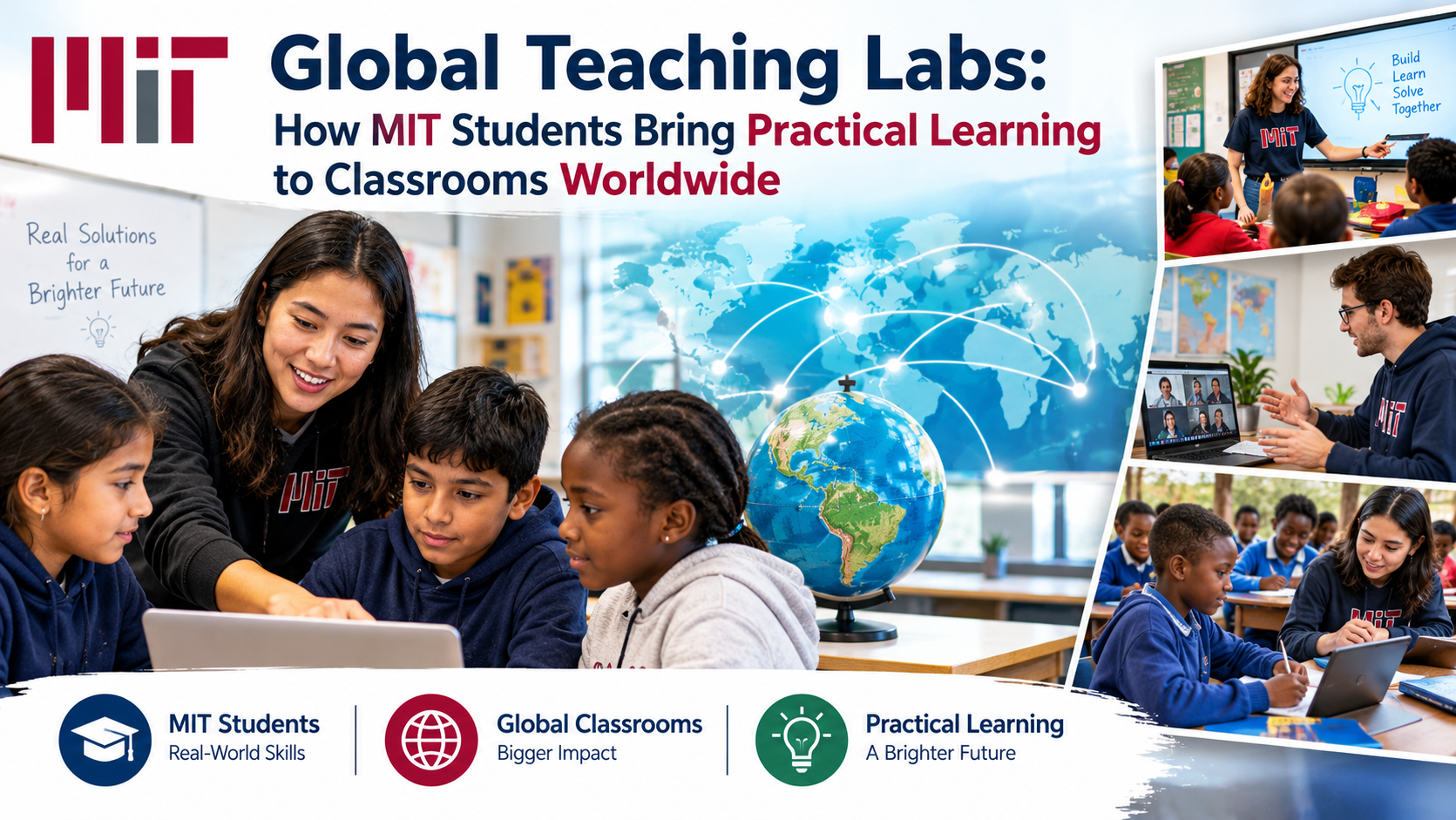
Global Teaching Labs (GTL) is an international education program run by the Massachusetts Institute of Technology’s International Science and Technology Initiatives (MISTI). It sends selected MIT students to schools and educational institutions in different countries to teach subjects such as science, technology, engineering, and mathematics. Participants gain practical teaching experience, collaborate with international educators, and explore different cultures while helping students learn through interactive, hands-on activities.
Introduction to Global Teaching Labs
Education becomes more meaningful when students can connect classroom knowledge with real-world applications. Global Teaching Labs is built around this principle, giving selected students from the Massachusetts Institute of Technology (MIT) an opportunity to share their knowledge with learners in international classrooms. Rather than focusing exclusively on traditional lectures, the program encourages interactive lessons, practical demonstrations, group projects, and problem-solving activities.
The initiative operates through MIT’s International Science and Technology Initiatives, commonly known as MISTI. This organization connects MIT students with international academic and professional opportunities. Through Global Teaching Labs, participants can experience education from a different perspective while introducing students abroad to new ways of understanding complex subjects. The program also helps participants develop communication, teamwork, adaptability, and leadership skills.
What Is the Main Purpose of Global Teaching Labs?
The central purpose of Global Teaching Labs is to encourage experiential learning by bringing MIT students into educational environments where they can teach, collaborate, and exchange ideas. The program reflects the belief that education is not limited to memorizing information. Students often develop a stronger understanding of scientific and technical concepts when they can experiment, ask questions, and apply ideas to practical situations.
Another important objective is to create meaningful connections between educational communities. Visiting MIT students work with local teachers and learners, adapting their knowledge to the needs of each classroom. These experiences can expose students to new academic possibilities, including engineering, computer science, mathematics, and emerging technologies. At the same time, visiting participants learn about local teaching methods, educational priorities, and cultural perspectives.
How the Program Works
Global Teaching Labs generally takes place during MIT’s Independent Activities Period, known as IAP, which occurs in January. Many placements last approximately three to four weeks, although schedules and arrangements vary by country and host institution. Selected participants travel to their assigned destinations and work with schools, universities, or other educational partners.
Before departure, participants receive preparation and training intended to help them succeed in unfamiliar classrooms. This preparation may cover teaching methods, communication, cultural awareness, and practical arrangements. Once at their host institution, participants may lead lessons, assist local teachers, conduct workshops, or develop hands-on learning activities. The precise responsibilities depend on the placement, subject area, and needs of the partner institution.
The experience is not identical in every country. Some placements involve working independently under a host teacher’s supervision, while others use small teams of MIT students. Certain programs emphasize classroom instruction, whereas others focus on specialized workshops, competitions, or technical projects. Applicants should therefore review the requirements and teaching format for their preferred destination.
Subjects Covered by Global Teaching Labs
The subjects offered through Global Teaching Labs depend on the host country and its educational priorities. Science, technology, engineering, and mathematics are central to the program, but some placements include entrepreneurship, debate, and other specialized topics.
Science, Technology, Engineering, and Mathematics
STEM education forms the foundation of many GTL placements. Participants may teach mathematics, physics, chemistry, biology, computer science, robotics, artificial intelligence, or other technical subjects. Some programs also explore data science, cybersecurity, embedded systems, and machine learning.
The teaching approach often emphasizes understanding rather than memorization. For example, a computer science lesson might involve designing a simple program, while a physics session could use demonstrations to explain an abstract principle. These activities encourage learners to investigate questions, test ideas, and develop confidence in solving unfamiliar problems.
Robotics and Emerging Technologies
Robotics and artificial intelligence are increasingly relevant to education, industry, and scientific research. Depending on the placement, Global Teaching Labs participants may introduce students to robotics, programming, automation, or technology-based problem-solving.
Practical workshops can help learners understand how technical concepts connect with real applications. Instead of only reading about a system, students may explore how its components work together or how a basic program controls a task. The specific equipment and activities depend on the host institution, available resources, and participants’ subject expertise.
Mathematics and Academic Competitions
Some placements focus on advanced mathematics and preparation for academic competitions. These programs may help students strengthen logical reasoning, recognize patterns, and approach challenging problems systematically.
Competition-focused teaching is different from a standard introductory mathematics lesson. Learners may need to explain their reasoning, compare alternative solutions, and work through unfamiliar questions. Such activities can encourage persistence and deeper mathematical understanding.
Entrepreneurship and Interdisciplinary Learning
Selected placements also include entrepreneurship, communication, or interdisciplinary projects. These activities connect technical knowledge with planning, creativity, collaboration, and decision-making.
For example, students might explore how a scientific idea could address a practical problem or discuss how technology can support a community. This broader approach helps learners see that innovation involves more than technical knowledge; it also requires understanding people, resources, and the challenges a solution is intended to address.
Where Do Global Teaching Labs Operate?
Global Teaching Labs has offered placements across several regions, including parts of Europe, Asia, Africa, and Latin America. Available countries, partner institutions, and teaching subjects change according to the program cycle.
Recent program information has included opportunities in countries such as India, Bhutan, Germany, Italy, Spain, the United Kingdom, Mexico, Peru, and South Korea, among others. These examples illustrate the program’s international reach rather than guaranteeing that every destination will be available in every year.
Each location can offer a different educational experience. One school may prioritize computer science and robotics, while another may focus on mathematics competitions or general science instruction. Local language expectations, housing arrangements, classroom responsibilities, and cultural activities can also differ.
For prospective applicants, choosing a destination should involve more than personal interest in a country. It is also important to consider subject knowledge, the needs of the host school, the teaching environment, and the ability to contribute meaningfully to the local learning community.
Who Can Apply for Global Teaching Labs?
Global Teaching Labs is primarily designed for MIT students who want to share their academic knowledge and develop practical teaching skills. It is not a general international exchange program open automatically to every university student. Applicants must meet MIT and MISTI requirements and apply through the relevant institutional process.
Academic standing is an important consideration. The published program requirements have included a minimum GPA of 4.0 on MIT’s grading scale, along with an application and interview. Selected students must also complete required preparation and training sessions before departure.
The program evaluates more than academic performance. Teaching requires the ability to explain difficult ideas clearly, listen to learners, respond to questions, and adapt when an activity does not go as planned. Applicants should demonstrate a genuine interest in education and an ability to work constructively with people from different backgrounds.
First-year eligibility, subject restrictions, language preferences, and other prerequisites can vary by placement. Some opportunities are available only to students with specific experience or qualifications. Applicants should confirm the current requirements rather than assuming that meeting the general criteria guarantees eligibility for every destination.
The Application and Selection Process
The application process generally begins with reviewing the available Global Teaching Labs placements and identifying suitable options. Students should compare the subjects taught, the expected classroom responsibilities, the duration of the placement, and any special qualifications required.
Applicants then complete the relevant MISTI application and provide the information requested by the program. An interview forms part of the selection process, allowing program staff to evaluate applicants’ academic preparation, communication abilities, adaptability, and suitability for a particular placement.
Successful applicants participate in pre-departure preparation. These sessions help them understand teaching expectations, cultural differences, travel arrangements, and the responsibilities associated with representing MIT in an international educational setting.
The timeline matters because GTL placements typically take place in January and applications are reviewed well before departure. Deadlines can change each year. Students interested in a future program should consult the latest official MIT MISTI information for application dates, available countries, interviews, and training requirements.
Is Global Teaching Labs Fully Funded?
Funding is an important consideration for students planning an international educational experience. MIT MISTI describes its programs as designed to be cost-neutral, with essential expenses covered through program donors, host institutions, or a combination of funding sources. Published GTL information has also described support for airfare and housing, along with a modest stipend for meals and transportation.
However, financial arrangements should not be assumed to be identical across all placements and program years. The exact coverage, accommodation options, travel arrangements, and any applicable conditions should be confirmed through the relevant program information.
Applicants should review the funding details before accepting a placement. Understanding what is covered helps students plan responsibly and avoid unexpected expenses. They should also clarify any requirements concerning travel documentation, insurance, accommodation, or other practical matters.
Benefits for Participating MIT Students
One of the most important benefits of Global Teaching Labs is the opportunity to learn through teaching. Explaining a subject to someone else requires participants to organize their knowledge, identify the most important concepts, and communicate them in a clear and accessible way.
The experience can also improve leadership and teamwork. Participants may need to prepare lessons, coordinate activities, respond to different learning needs, and collaborate with local teachers or fellow MIT students. These responsibilities provide opportunities to develop skills that are valuable in academic research, industry, and future leadership roles.
Cultural exchange is another significant benefit. Working in an unfamiliar environment encourages participants to consider different perspectives and adapt to local expectations. They may discover that an effective teaching method in one classroom needs to be adjusted for another group of learners.
Although the program can strengthen a participant’s experience and skills, it does not guarantee a particular job, academic outcome, or future career opportunity. Its value depends partly on how participants approach the experience, reflect on their learning, and apply those skills afterward.
How Host Schools and Local Students Benefit
Host institutions can benefit from new teaching activities, additional academic perspectives, and opportunities to explore specialized subjects. Depending on the placement, MIT students may support existing lessons, develop workshops, introduce technical projects, or help learners investigate subjects that receive limited attention in their regular curriculum.
For local students, the opportunity to participate in practical lessons can make complex topics feel more approachable. An interactive activity may encourage a learner who has previously struggled with a technical subject to ask questions or explore an idea independently. Exposure to different teaching styles can also help students recognize that there are multiple ways to understand and solve a problem.
These benefits depend on effective collaboration. Visiting students are most useful when they coordinate with local educators, respect the existing curriculum, and adapt their lessons to students’ abilities and needs. International programs work best when knowledge flows in both directions and local expertise is valued.
Challenges and Responsibilities in International Teaching
Teaching abroad can be rewarding, but it also involves practical and educational challenges. Language differences may affect how easily participants explain a concept or understand a student’s question. Classroom sizes, technology access, curriculum expectations, and available materials may also differ from what visiting students are accustomed to.
Cultural awareness is essential. Participants must avoid assuming that one teaching method will work equally well in every environment. They need to listen to local educators, respect school policies, and make adjustments when necessary. Patience and flexibility can be just as important as technical expertise.
There is also a responsibility to prepare lessons that are useful rather than simply impressive. Advanced subject knowledge does not automatically translate into effective teaching. A successful lesson needs clear objectives, suitable examples, opportunities for student participation, and an appropriate level of difficulty.
These challenges help explain why preparation and collaboration are important parts of Global Teaching Labs. The program is not simply about traveling internationally; it is about contributing responsibly to an educational setting while learning from the people who live and work there.
Global Teaching Labs Compared With Other MIT International Programs
MIT offers several types of international opportunities through MISTI, but each has a different emphasis. Global Teaching Labs focuses on teaching and educational exchange, while other initiatives may emphasize research, professional internships, entrepreneurship, or study abroad.
For instance, international internships typically give students practical experience in companies, research laboratories, or other professional environments. Global Startup Labs focuses more directly on technology entrepreneurship and related skills. Study abroad opportunities allow students to pursue academic coursework in another country.
Global Teaching Labs is particularly relevant to students who enjoy explaining ideas, working with learners, and applying academic knowledge in a classroom. Students who prefer laboratory research or professional workplace experience may find another MISTI pathway more closely aligned with their goals.
The most suitable opportunity depends on a student’s interests, qualifications, and desired learning outcomes. Comparing the program structures before applying can help students make an informed decision.
Frequently Asked Questions About Global Teaching Labs
1. What does Global Teaching Labs mean?
Global Teaching Labs is an international teaching initiative operated through MIT’s International Science and Technology Initiatives. It gives selected MIT students opportunities to teach subjects such as STEM, conduct workshops, and collaborate with educational institutions in other countries.
2. Is Global Teaching Labs only for STEM subjects?
STEM subjects are central to the program, including mathematics, science, engineering, and computer science. However, certain placements also offer topics such as entrepreneurship and debate. Available subjects depend on the country and host institution.
3. Does Global Teaching Labs cover travel and accommodation?
Published MISTI program information describes GTL funding as designed to cover essential expenses, including airfare and housing, with support potentially provided by donors and host institutions. Students should verify the exact financial arrangements for their chosen placement and program year.
4. How long does Global Teaching Labs last?
Many GTL placements take place for approximately three to four weeks during January. Exact dates and durations vary by country and host institution, so applicants should check the current program schedule.
5. Can any university student apply?
The program is primarily intended for eligible MIT students. Applicants must meet the relevant academic and program requirements, complete the application and interview process, and participate in required preparation. Eligibility for individual placements can vary.
6. Does Global Teaching Labs require previous teaching experience?
Teaching experience may be helpful, but requirements depend on the placement. Some opportunities specify prior teaching experience or other qualifications, while others emphasize subject knowledge, communication skills, and the ability to guide learners. Applicants should check the requirements for each option.
Conclusion
Global Teaching Labs demonstrates how international education can connect academic knowledge with practical teaching and cultural exchange. Through MIT MISTI, selected students have opportunities to work with schools and learners in different countries, introduce engaging approaches to STEM education, and strengthen their communication and leadership skills.
The program’s value extends beyond the classroom. Participants learn to adapt their knowledge to new environments, while host institutions and students gain opportunities to explore ideas through interactive lessons and collaborative activities. Although eligibility, funding, subjects, and destinations vary, the central purpose remains focused on learning through teaching.
For eligible MIT students who want to share their knowledge and experience education from a global perspective, Global Teaching Labs can be a meaningful opportunity to contribute to international learning while developing skills that remain useful long after the placement ends.