

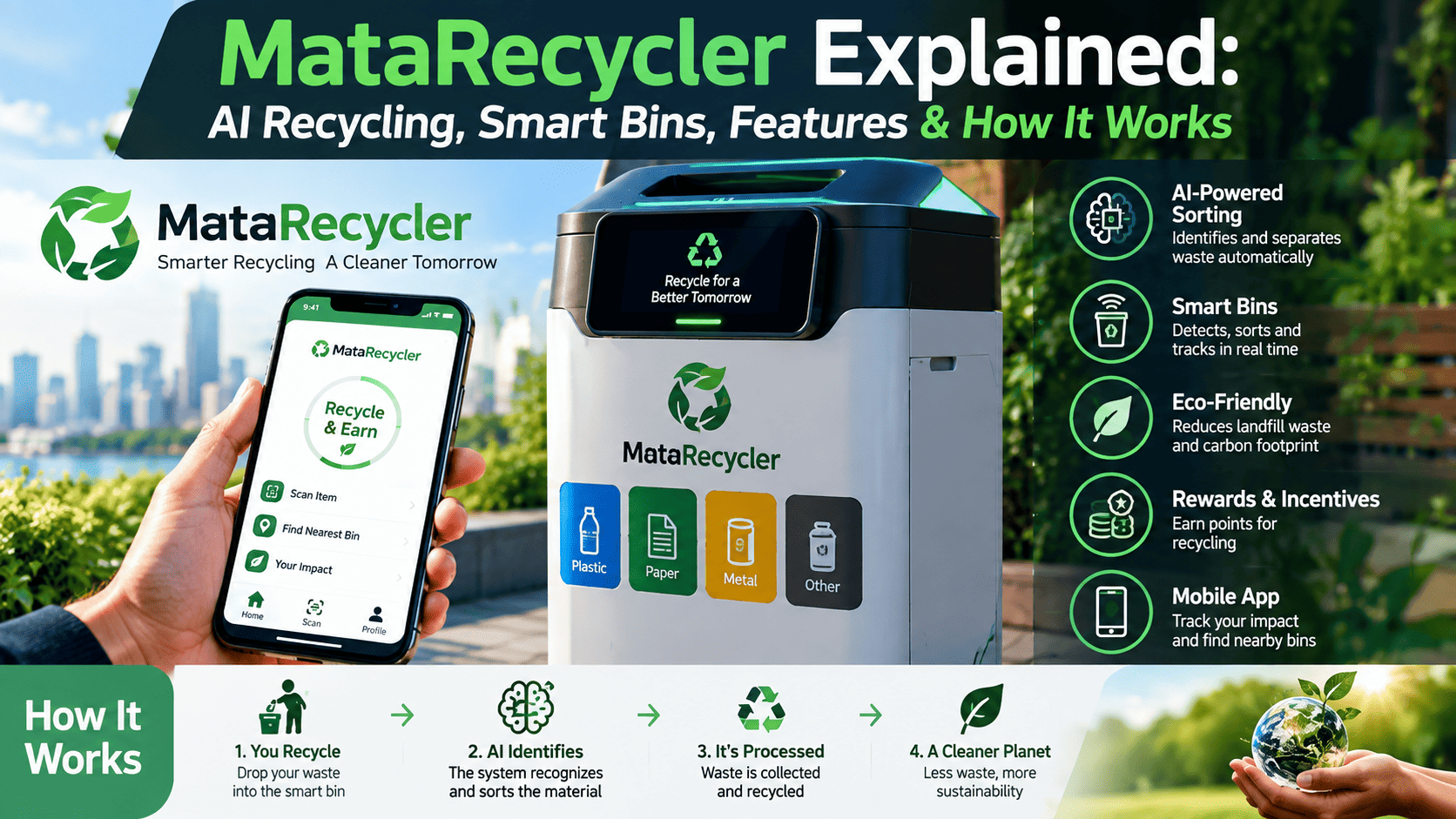
MataRecycler is associated with the idea of using artificial intelligence, smart sensors, automation, and data-driven technology to make recycling and waste management more efficient. The concept focuses on identifying waste, improving sorting, reducing contamination, monitoring collection needs, and helping organizations manage recyclable materials more intelligently. Because publicly available information about MataRecycler is limited and sometimes inconsistent, specific product features should be verified before treating them as confirmed.
What Is MataRecycler?
MataRecycler is a name used in online discussions about smarter recycling and technology-assisted waste management. At its core, the concept is about using modern technology to improve one of the biggest challenges in recycling: correctly identifying and separating waste.
Traditional recycling depends heavily on people placing items into the correct containers and workers or machines sorting materials afterward. That process can become difficult when waste contains mixed materials, contaminated packaging, unusual products, or items that look similar but require different processing.
The technology associated with MataRecycler is intended to make this process more intelligent. Artificial intelligence, cameras, sensors, automated sorting equipment, and data systems can potentially work together to identify materials and improve how waste moves through a recycling operation.
However, it is important to distinguish between the general technology behind smart recycling and features that have been specifically confirmed for MataRecycler. Public information about the name is not detailed enough to establish a single, complete official specification covering every feature sometimes mentioned online.
How Does MataRecycler Work?
A smart recycling system generally begins when a person places an item into a collection point or automated bin. Cameras and sensors can collect information about the object, while software analyzes that information to determine its likely material category.
For example, an intelligent system may examine an object’s visual characteristics, dimensions, shape, texture, or other measurable properties. AI models can then compare those characteristics with patterns learned from previously analyzed materials.
If the system determines that an item belongs to a particular recycling category, automated equipment can potentially direct it toward the appropriate collection stream. In a more advanced facility, this could involve conveyor systems, mechanical sorting equipment, robotic technology, or other automated machinery.
The process can also generate operational data. A connected recycling system may record information about waste volumes, material categories, bin capacity, collection requirements, or sorting performance.
This creates an important difference between a traditional bin and a smart recycling system: the latter can potentially become a source of useful information rather than simply a container for waste.
How AI Can Improve Recycling
Artificial intelligence is particularly useful in recycling because waste is highly variable.
Two objects may have similar shapes but be made from completely different materials. Packaging can also contain several layers, coatings, adhesives, or combinations of plastic, paper, and metal.
AI-based computer vision can help analyze visual characteristics that may be difficult to interpret consistently through simple rules. Machine-learning models can be trained using large collections of images and material examples so that they can classify objects according to learned patterns.
The goal is not to make AI replace every human involved in recycling. Instead, AI can support identification and sorting tasks that are repetitive, time-consuming, or difficult to perform consistently at scale.
The quality of an AI recycling system depends heavily on its training data, sensors, hardware, software, maintenance, and the types of materials it is designed to recognize.
The Role of Smart Sensors
Sensors are another important part of intelligent waste management.
A sensor can provide information that a camera alone cannot. Depending on the system, sensors may help detect the presence of an object, estimate the amount of waste inside a container, measure weight, or monitor other physical conditions.
One particularly useful application is fill-level monitoring. Instead of waiting until a recycling bin overflows or sending a collection vehicle according to a fixed schedule, a connected system can potentially report when a container is approaching capacity.
This information can help waste managers make collection decisions based on actual conditions.
Smart sensors can therefore contribute to two separate goals: better recycling operations and better collection efficiency.
What Are Smart Recycling Bins?
A smart recycling bin is more than a conventional container. It can incorporate technology that helps monitor, identify, communicate, or manage the waste placed inside it.
Some smart bins focus mainly on fill-level monitoring. Others can provide users with information about where particular materials belong. More advanced systems may combine sensors, cameras, connectivity, and automated sorting mechanisms.
A smart bin connected to a central dashboard could potentially provide information from multiple locations at once. This would allow an organization to see which containers are full, which locations generate the most waste, and where collection resources may be needed.
This type of infrastructure is particularly useful for large buildings, campuses, public spaces, commercial facilities, and municipal waste networks.
Key Features Associated With MataRecycler
Several features are commonly associated with the idea of MataRecycler and intelligent recycling technology.
AI-Powered Material Recognition
AI can help identify different categories of waste by analyzing information captured through cameras and sensors. This may reduce some sorting errors and make material separation more consistent.
Computer Vision
Computer vision allows software to interpret visual information. In recycling applications, it can potentially identify an object’s shape, appearance, packaging characteristics, and other visible features.
Smart Sensors
Sensors can monitor waste containers and provide information about capacity, activity, or other conditions. This can support more responsive waste collection.
Automated Sorting
Automation can move identified materials into appropriate streams. In large facilities, this can reduce dependence on repetitive manual sorting.
Waste Analytics
Data collected from smart recycling equipment can provide insights into waste volumes, material categories, collection patterns, and operational performance.
Remote Monitoring
Connected equipment can potentially allow operators to monitor multiple recycling points through a centralized system rather than physically inspecting every container.
Collection Optimization
When accurate fill-level information is available, collection teams can prioritize containers that actually need service. This may reduce unnecessary trips and improve operational efficiency.
It is important to note that these are technologies associated with smart recycling and descriptions of MataRecycler; they should not automatically be interpreted as a confirmed feature list for one specific commercial product.
What Materials Can Smart Recycling Systems Identify?
The materials handled by an intelligent recycling system depend on its hardware, software, training data, and the recycling infrastructure connected to it.
Common categories can include:
- Plastic
- Paper
- Cardboard
- Glass
- Aluminum
- Steel
- Certain packaging materials
- Other recyclable materials supported by the facility
Plastic can be particularly challenging because different plastic types may require different processing methods. Paper and cardboard can also become difficult to recover when they are wet or heavily contaminated.
Glass and metal generally have different physical characteristics, which can make automated identification easier in certain systems.
The biggest challenge is often mixed-material packaging. A single product may contain plastic, foil, paper, glue, coatings, or multiple layers. Identifying such products correctly requires more than simply recognizing the object’s appearance.
Therefore, readers should not assume that every version of a smart recycling system can process every recyclable material.
Why Recycling Contamination Is a Major Problem
Recycling contamination occurs when inappropriate materials enter a recycling stream.
For example, food residue, non-recyclable packaging, plastic bags, liquids, or unrelated waste can contaminate materials that would otherwise be recyclable.
Contamination creates additional sorting work and can reduce the quality of recovered materials. In severe cases, an entire load can become difficult or uneconomical to process.
This is one reason intelligent sorting technology is attracting attention.
If a system can identify an incorrect item before it enters a particular recycling stream, it may help reduce contamination. The technology can potentially guide users, flag unsuitable materials, or automatically separate objects.
However, AI does not eliminate contamination completely. Unusual packaging, dirty materials, damaged products, and new materials can still create classification challenges.
Benefits of AI-Powered Recycling
The biggest potential advantage of intelligent recycling is improved efficiency.
When materials are identified and separated more accurately, recycling facilities may be able to recover more useful material from mixed waste.
Another benefit is consistency. Automated systems can perform repetitive classification tasks continuously without becoming tired or distracted.
Smart monitoring can also improve collection operations. If a waste manager knows which bins are nearly full, collection resources can be prioritized accordingly.
Data is another major advantage. Traditional waste systems often provide limited information about exactly what is being discarded and where. Smart systems can potentially create a much clearer picture.
That information can help businesses, schools, municipalities, and other organizations identify waste patterns and improve their recycling strategies.
MataRecycler for Businesses
Businesses can produce significant quantities of packaging, paper, plastic, and other waste every day.
For these organizations, better sorting can potentially reduce the amount of recyclable material that ends up in general waste.
Smart recycling technology can also help businesses understand where their waste is coming from. A company could analyze waste patterns across offices, departments, buildings, or facilities and identify areas where better recycling practices are needed.
Data can also support sustainability reporting and internal environmental goals.
However, technology should not be viewed as a substitute for a complete recycling program. Businesses still need appropriate collection containers, employee education, reliable waste contractors, and access to facilities capable of processing the recovered materials.
MataRecycler for Schools and Universities
Educational institutions can benefit from smart recycling for both operational and educational reasons.
Schools and universities produce waste from classrooms, cafeterias, offices, events, and public areas. Clear recycling systems can help students and staff understand how different materials should be separated.
Smart bins can potentially provide immediate guidance or make recycling stations easier to understand.
Universities can also use waste data to study consumption and disposal patterns across campus.
The educational value is especially important because long-term recycling improvement depends partly on human behavior. Technology can make the correct decision easier, but people still need to participate.
MataRecycler and Smart Cities
Smart recycling fits naturally into the broader smart-city movement.
Modern cities increasingly use sensors and connected systems to monitor public infrastructure. Waste collection can benefit from the same approach.
Connected recycling bins can potentially report their fill levels, allowing collection teams to prioritize locations based on real-time needs.
Over time, cities can analyze this information to identify areas with unusually high waste production, determine where additional recycling infrastructure is needed, and improve collection schedules.
The result could be a waste-management network that responds to actual demand rather than relying entirely on fixed routes and schedules.
This does not mean every city needs fully automated recycling. The appropriate technology depends on population size, infrastructure, budget, waste composition, and local recycling facilities.
Can MataRecycler Reduce Waste Collection Costs?
Smart collection technology has the potential to reduce unnecessary collection trips.
A conventional collection route may visit every bin according to a predetermined schedule, even when some containers are only partially full.
A connected system can potentially identify which containers need attention and help prioritize them.
This may reduce fuel consumption, vehicle mileage, labor time, and unnecessary servicing.
However, savings are not guaranteed. The actual financial impact depends on the number of bins, collection distances, labor costs, equipment expenses, maintenance requirements, and local operating conditions.
Therefore, claims of a specific percentage reduction in collection costs should not be accepted without a documented case study.
Environmental Impact of Smart Recycling
The environmental argument for smart recycling is straightforward: better sorting can help keep more useful materials within the recycling system.
Recovering materials such as metals, paper, glass, and certain plastics can reduce the need to obtain some new raw materials.
More efficient collection may also reduce unnecessary vehicle movement.
At the same time, smart recycling technology has its own environmental footprint. Sensors, cameras, computers, batteries, and automated equipment require resources to manufacture, operate, and eventually replace.
The best solution is therefore not simply to add more technology. It is to use technology where it produces measurable improvements in material recovery, collection efficiency, and waste reduction.
Limitations of MataRecycler
Smart recycling is promising, but it has important limitations.
Cost
Advanced equipment can require significant investment. Hardware, software, installation, maintenance, and connectivity all contribute to the total cost.
Maintenance
Cameras and sensors need to remain clean and functional. Mechanical systems also require maintenance and replacement of worn components.
Difficult Materials
Mixed-material packaging, dirty items, and unusual products can be difficult for AI systems to classify correctly.
Infrastructure
A smart sorting system is only useful when there is a recycling facility capable of processing the materials it identifies.
Human Participation
People still influence recycling outcomes. Incorrect disposal, poor understanding of local rules, and lack of participation can reduce the effectiveness of even advanced systems.
Data and Privacy
Connected systems may collect operational data and, depending on their design, potentially visual information. Organizations need appropriate privacy and security policies when deploying connected recycling technology.
Is MataRecycler a Real Product?
This is where readers should be careful.
Online descriptions of MataRecycler present it as an intelligent recycling solution involving AI, smart bins, sensors, automation, and waste management. However, publicly available information does not provide a sufficiently clear, authoritative product specification confirming every feature attributed to the name.
There are also differences between descriptions. Some references emphasize physical smart recycling infrastructure, while others describe digital or app-like recycling assistance.
That inconsistency means it would be misleading to state with complete certainty that every technology, capability, deployment, or performance figure mentioned online belongs to one verified MataRecycler product.
The broader technology is absolutely real. AI-powered sorting, computer vision, robotic recycling, smart bins, IoT sensors, and waste analytics are established areas of modern waste management.
The unanswered question is how much of that technology can specifically and reliably be attributed to MataRecycler.
Who Developed MataRecycler?
Reliable public information about the company, organization, or development team behind MataRecycler is limited.
A strong technology profile would normally include information such as the developer, headquarters, official website, product documentation, technical specifications, customer deployments, pricing, and support information.
Where those details are unavailable, readers should be cautious about highly specific claims.
This is particularly important for articles that mention exact performance percentages, named deployments, financial savings, or worldwide availability without providing primary documentation.
How to Evaluate MataRecycler Claims
If you are considering MataRecycler or researching it for a business or organization, look for primary evidence rather than relying only on articles repeating the same information.
Useful evidence includes:
- Official product documentation
- Identifiable company information
- Technical specifications
- Named customer case studies
- Independent testing
- Demonstrations of the technology
- Clear pricing information
- Privacy and data policies
- Hardware and safety certifications where applicable
This approach helps separate genuine product capabilities from generalized claims about what AI recycling technology can theoretically accomplish.
The Future of AI Recycling
AI is likely to play a growing role in recycling as computer vision, robotics, sensors, and machine learning continue to improve.
Future systems may become better at recognizing complex packaging and distinguishing between materials that currently look similar.
Robotic systems may also become faster and more precise, allowing recycling facilities to process larger quantities of material with less manual intervention.
Smart bins could become increasingly connected to city-wide waste platforms. Instead of operating independently, individual bins may become part of a larger network that monitors waste generation and collection needs.
Predictive analytics could also become more important. Instead of simply reporting that a bin is full, future systems could predict when it is likely to reach capacity and help schedule collection before overflow occurs.
The long-term goal is not simply smarter bins. It is a more intelligent circular economy, where materials are tracked, recovered, reused, and recycled as efficiently as possible.
Final Verdict: Is MataRecycler Worth Paying Attention To?
MataRecycler is an interesting concept because it connects several important developments in modern waste management: artificial intelligence, computer vision, smart sensors, automation, connected infrastructure, and waste analytics.
The potential benefits are significant. Better identification could reduce sorting mistakes, smart monitoring could improve collection efficiency, and waste data could help organizations make more informed decisions.
But the technology should be evaluated realistically.
Public information about MataRecycler itself remains limited, and some online descriptions appear to combine confirmed smart-recycling concepts with claims that are difficult to independently verify. For that reason, specific claims about ownership, pricing, performance, availability, and exact features should be checked against authoritative sources.
The broader technology, however, is clear. AI and automation are already changing how recycling systems approach material identification and sorting.
If MataRecycler develops into a clearly documented and independently validated solution, it could become an interesting example of how technology can support cleaner, more efficient recycling.
Frequently Asked Questions
What is MataRecycler?
MataRecycler is associated with smart recycling and technology-assisted waste management. It is described in online material as using concepts such as AI, sensors, automation, and data analytics to improve waste sorting and recycling efficiency.
How does MataRecycler use AI?
AI can analyze information from cameras and sensors to help classify waste according to material characteristics. The resulting classification can potentially support automated sorting.
What are smart recycling bins?
Smart recycling bins are technologically enhanced containers that may use sensors, cameras, connectivity, or software to monitor waste, guide users, identify materials, or report fill levels.
What materials can AI recycling systems identify?
Depending on the technology, AI recycling systems can identify materials such as plastic, paper, cardboard, glass, aluminum, and steel. The exact capabilities depend on the equipment and recycling facility.
Can MataRecycler reduce recycling contamination?
Smart sorting technology may reduce contamination by identifying unsuitable materials before they enter a particular recycling stream. Its effectiveness depends on the technology, training data, local recycling rules, and operating conditions.
Is MataRecycler available for homes?
Public information does not clearly establish a single residential MataRecycler product or standard household package. Any residential availability should be confirmed through an authoritative source.
How much does MataRecycler cost?
A reliable official price has not been established from the publicly available information discussed here. Installation, hardware, software, and maintenance costs would also need to be considered for a commercial system.
Is MataRecycler really AI-powered?
MataRecycler is described online using AI and smart-recycling terminology, but the exact technical implementation has not been sufficiently documented to independently confirm every AI capability attributed to it.
What is the future of AI recycling?
AI recycling is likely to expand through better computer vision, robotics, smart sensors, predictive analytics, and connected waste-management systems. These technologies could make material recovery more efficient while reducing some collection and sorting challenges.