

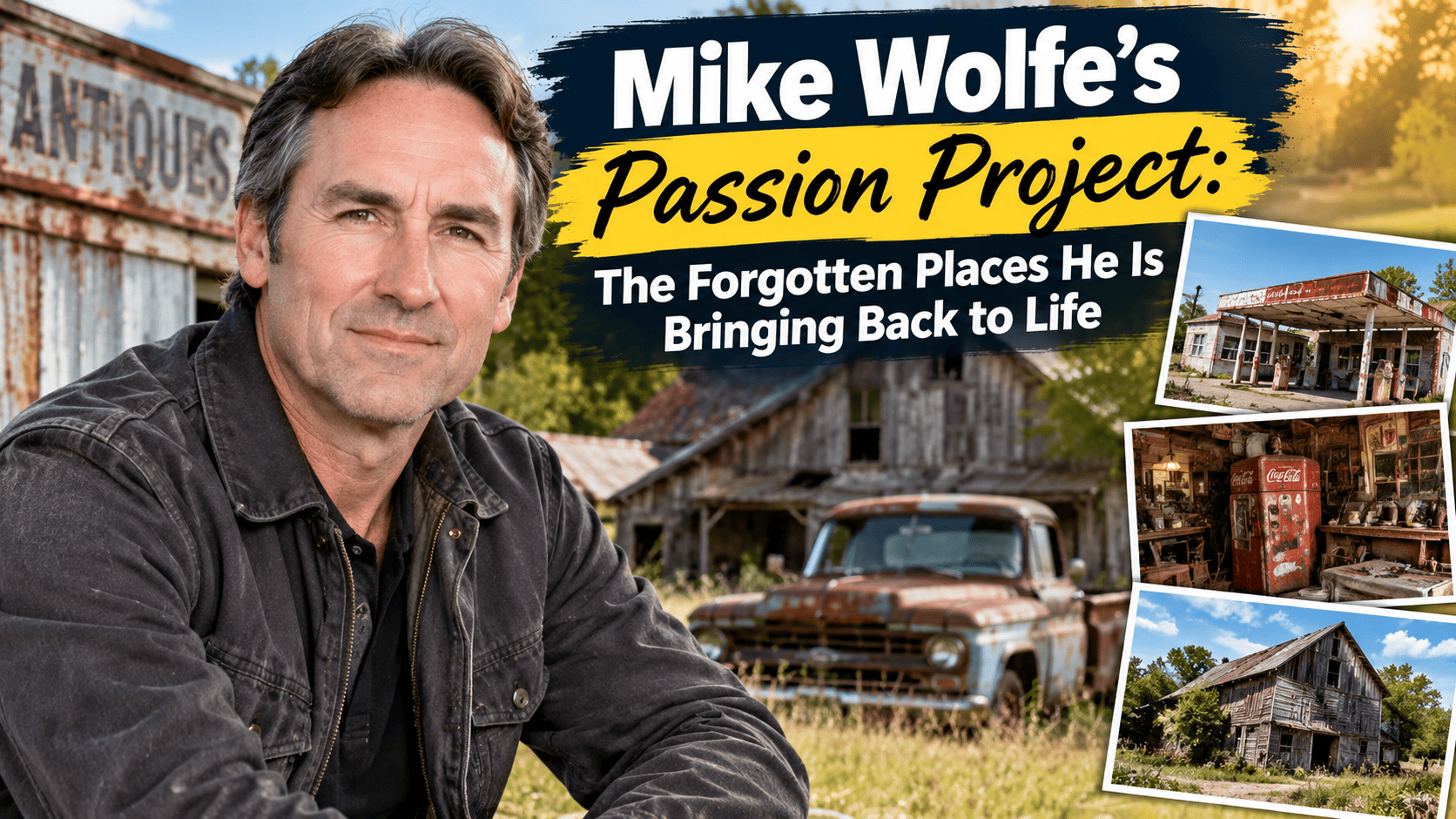
Mike Wolfe’s passion project is his broader effort to preserve America’s history by restoring neglected buildings, collecting antiques, and helping historic small towns maintain their character. Best known as the creator and star of American Pickers, Wolfe looks beyond valuable collectibles to the stories behind old structures, vintage vehicles, and forgotten places. One notable example is his restoration of a former Esso gas station in Columbia, Tennessee, which he envisioned as a community gathering space.
Who Is Mike Wolfe?
Mike Wolfe is an American television personality, antique collector, entrepreneur, and historic preservation enthusiast best known for American Pickers. The History Channel series follows collectors as they travel across the United States searching for antiques, vintage memorabilia, old vehicles, and other objects that reveal stories about everyday American life.
Wolfe developed an interest in old objects long before becoming a television personality. His approach to collecting is based on recognizing value in things that other people may consider outdated or forgotten. An old advertising sign, a motorcycle from another era, or a weathered storefront can offer a glimpse into how people lived, worked, traveled, and built their communities.
Over time, this interest expanded beyond collecting individual objects. Wolfe became increasingly associated with preserving historic buildings and finding new uses for properties that might otherwise be neglected or demolished. This broader mission is the foundation of what people commonly call his passion project.
What Makes Mike Wolfe’s Passion Project Different?
Many people recognize Wolfe for finding rare antiques and negotiating purchases on television. However, his interest in preserving history extends beyond buying and selling collectibles. He has repeatedly shown an appreciation for the buildings, businesses, and communities connected to America’s past.
Historic structures often carry details that cannot easily be recreated. Their original materials, architectural features, signs, and layouts reflect the periods in which they were built. When these places disappear, communities can lose physical reminders of their own development.
Wolfe’s preservation philosophy focuses on recognizing that value before it is lost. Instead of automatically treating an aging building as an obstacle to development, he looks at what makes it distinctive and considers how it might serve a new purpose. This approach connects antique collecting with a wider interest in architecture, transportation history, and community identity.
His work also highlights an important idea: preserving the past does not necessarily mean keeping everything unchanged. A historic property can be repaired, adapted, and used by modern businesses while retaining features that make it meaningful.
The Historic Esso Gas Station in Columbia, Tennessee
One of the clearest examples of Mike Wolfe’s passion project is a former Esso gas station in downtown Columbia, Tennessee. The small building attracted attention because it represented an earlier period of American road travel, when neighborhood service stations were familiar landmarks in towns and cities.
Wolfe purchased the property with the intention of giving the neglected space a new purpose. Rather than simply removing the structure and replacing it with something unrelated, he pursued a restoration that would preserve its connection to the area’s automotive history.
In May 2025, Wolfe shared an update revealing the restored outdoor space. His public comments described the location as a place where the community could gather and enjoy the property for years to come. The design included outdoor seating, lighting, landscaping, and a fire feature, creating an inviting environment around the historic structure.
The project illustrates the difference between ordinary redevelopment and preservation-minded redevelopment. The goal was not just to improve a property’s appearance. It was also to retain a recognizable piece of local history while making the location useful in contemporary life.
The gas station is particularly relevant to Wolfe because of his long-standing interest in transportation-related collectibles. Vintage cars, motorcycles, service stations, and old dealerships all help tell the story of how Americans traveled and how roadside businesses became part of everyday culture.
Why Columbia Motor Alley Matters
Another important part of Wolfe’s preservation work is Columbia Motor Alley, a historic automotive property in Columbia, Tennessee. The building was associated with the Chevrolet dealership business and represents the type of commercial architecture that once played an important role in local transportation and trade.
Automotive properties can be especially valuable to preservation enthusiasts because they connect architecture with the history of mobility, manufacturing, and small business. Old dealerships and service stations were not merely places to purchase or repair vehicles. They were also gathering points for customers, workers, and local residents.
Preserving such buildings can help a town maintain a connection to its commercial past. When an old property receives a new use, it can remain part of the streetscape instead of becoming another lost landmark.
Wolfe’s interest in properties like Columbia Motor Alley reflects his belief that overlooked buildings deserve consideration before demolition. Their future does not always need to repeat their original function. A former dealership may be adapted for retail, events, or other activities, provided the renovation respects the structure’s important features.
The wider lesson is that local history is often preserved through practical decisions made about ordinary buildings. A town’s heritage is not limited to museums or famous monuments; it can also be found in former workshops, storefronts, garages, and service stations.
Restoring Old Buildings Without Losing Their Character
Historic restoration requires more thought than simply making an old structure look new. Buildings age in different ways, and some features may be difficult or expensive to repair. Owners must consider structural safety, building codes, accessibility, maintenance, and the needs of future occupants.
Preservation-minded redevelopment tries to balance these requirements with the building’s original identity. Distinctive brickwork, rooflines, windows, signs, and other architectural elements may help explain the property’s history. Retaining suitable original features can give a restored building a sense of continuity that a completely new construction may not provide.
Wolfe’s projects draw attention to this balance. An abandoned property can become attractive and useful without erasing every sign of its past. Modern improvements can support a new business or community activity while the structure continues to communicate something about the period in which it was built.
This approach is often described as adaptive reuse. It involves giving an existing building a new function rather than demolishing it and starting from scratch. When carefully planned, adaptive reuse can preserve local character while allowing a property to meet present-day needs.
The process is not always straightforward, and not every old building can be saved economically or safely. Nevertheless, Wolfe’s work encourages people to consider a property’s historical and cultural value before deciding that replacement is the only practical option.
Two Lanes and the Beauty of Small-Town America
Mike Wolfe’s interest in historic preservation is closely connected to his appreciation for small towns, back roads, and local stories. His Two Lanes brand reflects an interest in American travel, vintage culture, craftsmanship, and the distinctive character of places that visitors may overlook when traveling between major cities.
Small towns often preserve details of earlier American life in their main streets, independent businesses, historic homes, and roadside architecture. These places can offer a different experience from large commercial districts dominated by standardized buildings and national chains.
Wolfe’s enthusiasm for these environments encourages people to pay attention to the journey as well as the destination. A quiet downtown, an old sign, a family-run shop, or a historic garage can reveal something about a community that would otherwise be easy to miss.
This interest is also connected to the broader idea of heritage tourism. Visitors who explore historic districts and independent businesses can learn about local traditions while supporting places that contribute to a town’s identity. However, tourism alone does not guarantee successful preservation. Buildings still require responsible management, investment, and long-term care.
For Wolfe, the appeal of small-town America is rooted in authenticity. Places with visible histories offer stories that cannot be reproduced simply by constructing a new building in an old-fashioned style.
How Antique Collecting Connects With Historic Preservation
The connection between antique collecting and building restoration is central to understanding Wolfe’s work. On American Pickers, an object’s importance often comes from the people who owned it, the business that used it, or the period it represents.
A vintage gas pump, for example, can help explain the development of roadside travel. An old advertising sign can reveal how businesses communicated with customers. A motorcycle may reflect changes in engineering, design, and popular culture.
Historic buildings function in a similar way, but on a larger scale. Their layouts and architectural details can reveal how people worked, traded goods, and organized everyday life. A former dealership or service station can provide context for the objects Wolfe collects.
When objects and buildings are preserved together, they can create a richer picture of the past. The building provides the setting, while the objects help illustrate the activities that once took place there.
This connection also explains why preservation can matter even when a property is not associated with a famous person or major historical event. Everyday places often hold the strongest connections to local memory because generations of residents have used them.
The Community Benefits of Saving Forgotten Places
Restoring a historic building can offer benefits beyond improving its physical appearance. A repaired property may attract a new tenant, support a small business, provide space for gatherings, or encourage visitors to explore a downtown district.
When several properties are improved over time, the combined effect may help make a historic area more inviting. Visitors who come to see one restored building may also discover nearby shops, restaurants, galleries, and other local attractions.
However, the economic benefits of preservation depend on circumstances. A renovation does not automatically create jobs or transform an entire town. Its success can depend on local demand, operating costs, accessibility, business planning, and whether the property continues to receive proper maintenance.
Wolfe’s projects nevertheless demonstrate why preservation can be considered part of community development. Instead of treating history and economic activity as competing priorities, adaptive reuse offers a way to combine them.
A building can remain a visible reminder of the past while serving present-day residents. That combination is particularly valuable in historic downtowns, where the character of individual properties contributes to the overall identity of the area.
Challenges Behind Historic Restoration
Although restored buildings can look impressive when a project is complete, the process often involves substantial challenges. Older properties may have structural damage, outdated electrical systems, water problems, or other issues that require professional assessment before renovation can begin.
Owners must also consider permits, local preservation rules, construction expenses, and the cost of adapting a building for modern use. Some historic features require specialized materials or skilled craftspeople, which can increase both the time and expense involved.
Finding a suitable future use is equally important. A building may be architecturally interesting, but it still needs a realistic plan for occupancy, maintenance, and operating costs. Without a sustainable purpose, even a carefully restored property may struggle to remain active over the long term.
These challenges help explain why preservation requires more than enthusiasm. It involves planning, investment, cooperation, and decisions about which features are most important to retain.
Wolfe’s public-facing projects bring attention to the potential rewards of this work, while also illustrating the broader question facing many historic communities: how can older places remain relevant without losing what makes them special?
Mike Wolfe’s Passion Project Beyond Television
Television introduced Wolfe to a broad audience, but his preservation interests are not limited to what viewers see on American Pickers. His work with antiques, vintage properties, and historic commercial buildings reflects a long-running interest in material culture and American history.
The television format focuses on the discovery of objects and the negotiations involved in acquiring them. Building restoration, by contrast, is a longer process that can involve architects, contractors, preservation specialists, local officials, business owners, and community members.
This distinction matters because the two activities serve different purposes. Collecting can rescue an individual object and preserve its story. Restoration can help maintain a physical place that contributes to a neighborhood’s identity.
Wolfe’s broader mission brings these interests together. Both approaches begin with recognizing that something overlooked may still possess value. Both require understanding its background, and both can give an object or property a future beyond abandonment.
His projects also encourage viewers to think differently about aging structures. Rather than seeing only deterioration, they can consider whether a building has architectural character, historical significance, or potential for a new use.
What Mike Wolfe’s Preservation Work Teaches Us
One lesson from Wolfe’s work is that history is not limited to grand monuments or nationally recognized landmarks. Ordinary buildings often document the development of transportation, commerce, manufacturing, and community life.
A second lesson is that preservation can be practical. Saving a building does not necessarily require turning it into a museum. With suitable planning, an old property can support a modern business or provide a place for people to meet.
A third lesson is that the past becomes easier to understand when its physical evidence remains visible. Old signs, vintage vehicles, historic storefronts, and traditional commercial buildings help connect present-day communities with earlier generations.
Finally, preservation requires a balance between respect for history and realistic future use. A property must be safe, maintained, and financially sustainable if it is to remain part of a community for years to come.
These principles explain why Wolfe’s projects attract interest beyond the world of antique collecting. They raise a broader question about what communities choose to save and how forgotten places can continue to contribute to everyday life.
Conclusion
Mike Wolfe’s passion project represents a broader commitment to recognizing and preserving the overlooked parts of American history. Through antique collecting, historic building restoration, and his interest in small-town communities, Wolfe has helped bring attention to places that might otherwise be forgotten.
The former Esso gas station in Columbia, Tennessee, provides a clear example of this approach. Its restoration demonstrates how a historic property can retain its connection to the past while being prepared for a new role. Columbia Motor Alley and Wolfe’s other preservation interests reflect the same appreciation for buildings that tell stories about American transportation and commerce.
Ultimately, the significance of Mike Wolfe’s work lies in the idea that old does not automatically mean worthless. A neglected building or forgotten object may still have cultural, architectural, or personal meaning. By recognizing that value and finding responsible ways to preserve it, communities can protect parts of their history while making room for the future.
Frequently Asked Questions
1. What is Mike Wolfe’s passion project?
Mike Wolfe’s passion project refers broadly to his interest in preserving American history through antique collecting, historic building restoration, and efforts to maintain the character of small-town communities. It is not limited to one building or business.
2. What gas station did Mike Wolfe restore?
Wolfe restored a former Esso gas station in downtown Columbia, Tennessee. In May 2025, he revealed the improved outdoor space and described his vision of creating a place where the community could gather.
3. Why does Mike Wolfe restore old buildings?
Wolfe has expressed a strong interest in protecting historic buildings and revitalizing small-town main streets. His projects reflect the belief that older structures can retain historical character while serving useful modern purposes.
4. Is Mike Wolfe’s passion project connected to American Pickers?
Yes, the interests are closely connected. American Pickers focuses on discovering antiques and the stories behind them, while Wolfe’s preservation work applies a similar appreciation for history to buildings and communities.
5. What is Columbia Motor Alley?
Columbia Motor Alley is a historic automotive property in Columbia, Tennessee, associated with a former Chevrolet dealership. It is an example of the transportation-related buildings that interest Wolfe as part of his wider preservation efforts.
6. What is adaptive reuse in historic preservation?
Adaptive reuse means giving an existing building a new function while retaining appropriate historic features. For example, a former service station might be adapted into a business or gathering space instead of being demolished.
7. Why is small-town preservation important to Mike Wolfe?
Small towns often retain historic storefronts, independent businesses, roadside landmarks, and architectural details that reflect local history. Preserving these features can help communities maintain their identity and create opportunities for appropriate new uses.