

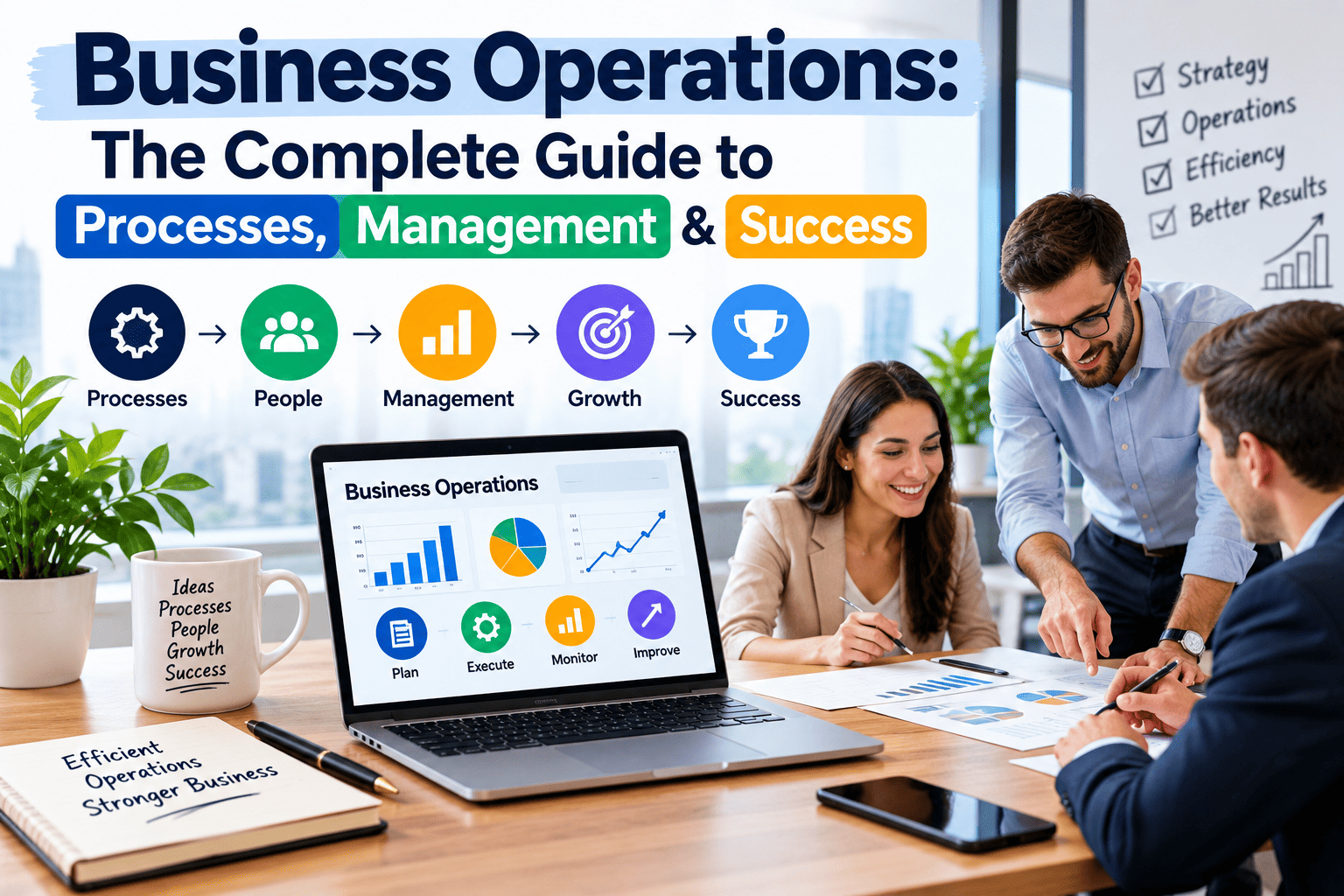
Business operations are the daily activities, processes, and systems that help a company deliver products or services, serve customers, manage resources, and generate revenue. Effective business operations combine people, technology, planning, and performance management to keep an organization running smoothly. By improving workflows, controlling costs, monitoring results, and maintaining quality, businesses can increase productivity, improve customer satisfaction, and build a strong foundation for long-term growth.
What Are Business Operations?
Business operations refer to the activities a company performs to keep its business running efficiently. These activities include managing employees, producing goods, delivering services, handling customer requests, maintaining inventory, processing orders, managing finances, and coordinating different departments. Although the exact responsibilities vary by industry, the purpose remains the same: to ensure that the organization can deliver value to customers while achieving its business objectives.
For example, an online clothing store depends on several operational activities to complete a single sale. It must maintain accurate product listings, manage inventory, process payments, package orders, arrange delivery, and respond to customer questions. If any of these activities fails, the customer experience may suffer. Well-managed business operations connect these activities so that orders are completed accurately and efficiently.
Business operations are important for organizations of every size. A small business may manage its operations through a few employees and simple software, while a large company may rely on specialized teams, automated systems, and detailed performance reports. Regardless of the organization’s size, clear processes and effective coordination help reduce mistakes, control expenses, and maintain consistent service quality.
Why Are Business Operations Important?
Business operations directly influence how effectively a company uses its time, money, people, and other resources. When daily activities are organized, employees understand their responsibilities, managers can identify problems more quickly, and customers receive more reliable products or services. Efficient operations also make it easier for a business to respond to changing market conditions without losing control of its costs or service standards.
One major benefit of strong operations is improved productivity. When employees follow clear procedures and have access to the right tools, they spend less time dealing with confusion, repeated tasks, and avoidable delays. This allows teams to focus on activities that contribute to customer satisfaction and business performance. Better productivity does not necessarily mean asking employees to work harder; it often means removing obstacles that prevent them from working effectively.
Another important benefit is cost control. Poorly managed operations can lead to excess inventory, wasted materials, unnecessary overtime, delayed deliveries, and repeated work. Businesses that regularly review their processes can identify these problems and make targeted improvements. Over time, even small efficiency gains can contribute to stronger profit margins and more predictable financial performance.
Key Components of Business Operations
Business operations consist of several connected components that work together to support the organization’s goals. The most important components depend on the company’s products, services, customers, and operating model, but most businesses need effective people management, reliable processes, appropriate technology, financial control, and performance measurement.
1. People and Workforce Management
Employees play a central role in business operations because they perform tasks, make decisions, solve problems, and interact with customers. Effective workforce management involves assigning responsibilities, establishing expectations, providing training, and ensuring that employees have the resources they need to perform their jobs. Managers must also coordinate workloads so that important tasks are completed on time without placing unnecessary pressure on individual team members.
A company can improve workforce performance by documenting job responsibilities, communicating priorities clearly, and providing regular feedback. For example, a customer support team may use a shared system to assign incoming requests, track response times, and identify unresolved issues. This approach makes responsibilities clearer and helps managers recognize when additional training or staffing is needed.
2. Business Processes and Workflows
Business processes describe the steps required to complete recurring activities. These may include approving purchases, onboarding new employees, processing customer orders, handling returns, or delivering professional services. A well-designed workflow identifies the sequence of tasks, the person responsible for each step, the information required, and the expected outcome.
Documented processes reduce uncertainty and help businesses maintain consistent standards. They also make it easier to train new employees and identify unnecessary steps. If an order requires several approvals that add little value, management can review the workflow and determine whether the process can be simplified without weakening financial controls or product quality.
3. Technology and Business Systems
Technology supports modern business operations by helping organizations organize information, automate repetitive tasks, and coordinate activities across departments. Common tools include accounting software, customer relationship management systems, inventory platforms, project management applications, and enterprise resource planning systems.
The right technology depends on a company’s actual needs. A small retailer may only require a point-of-sale system and inventory software, while a larger manufacturer may need integrated systems for purchasing, production planning, warehousing, and finance. Businesses should evaluate whether a tool solves a specific operational problem rather than adopting software simply because it offers many features.
4. Financial and Resource Management
Financial management is an essential part of business operations because every activity uses resources. Companies need to monitor operating expenses, manage cash flow, plan budgets, review supplier costs, and evaluate the financial impact of their decisions. Managers should understand which activities create value and which consume resources without delivering sufficient benefits.
Effective resource management also includes equipment, facilities, materials, and working time. For example, a restaurant can reduce unnecessary food waste by monitoring ingredient usage, forecasting demand, and improving stock rotation. These changes can support better cost control while maintaining food quality and customer service.
5. Quality Control and Customer Service
Quality control helps businesses ensure that their products and services meet established standards. Depending on the industry, quality management may involve product inspections, testing, customer feedback, compliance checks, or regular reviews of completed work. Consistent quality reduces avoidable errors and helps protect the company’s reputation.
Customer service is closely connected to operational quality. Delayed orders, inaccurate information, and repeated service failures often indicate weaknesses in internal processes. By recording customer complaints, identifying recurring problems, and correcting their underlying causes, businesses can improve both operational performance and customer satisfaction.
What Is Business Operations Management?
Business operations management is the process of planning, organizing, monitoring, and improving the activities that produce and deliver a company’s goods or services. It focuses on ensuring that resources are used effectively, workflows operate reliably, and business objectives can be achieved at an appropriate cost and level of quality.
Operations managers may oversee production schedules, staffing requirements, inventory levels, supplier relationships, service delivery, and process improvement initiatives. Their responsibilities vary by organization. In a manufacturing company, the role may focus on production efficiency and quality standards. In a service business, it may involve employee scheduling, customer response times, project delivery, and service consistency.
Successful operations management requires a balance between efficiency and reliability. Reducing costs is valuable, but cutting essential training, maintenance, or quality checks may create more expensive problems later. Effective managers consider the full impact of operational decisions and seek improvements that benefit the business over time rather than producing short-term savings at the expense of long-term performance.
Main Types of Business Operations
Different types of business operations support different parts of the organization. Understanding these areas helps managers identify responsibilities, coordinate departments, and determine where improvements may have the greatest impact.
Production and Service Delivery
Production operations transform raw materials, components, labor, or other inputs into finished products. Service operations deliver expertise, assistance, experiences, or specialized work to customers. Both require appropriate planning, resource allocation, quality standards, and performance monitoring.
For example, a furniture manufacturer must coordinate material purchasing, equipment availability, production schedules, and product inspections. A consulting firm must manage client requirements, employee availability, project milestones, and the quality of its recommendations. Although their activities differ, both organizations need reliable systems to deliver the promised value.
Supply Chain and Inventory Management
Supply chain operations involve sourcing materials, coordinating suppliers, transporting goods, and ensuring that products reach the appropriate locations. Inventory management focuses on maintaining suitable stock levels so that the business can meet demand without tying up excessive money in unsold goods.
Poor inventory management can cause stock shortages, delayed orders, or unnecessary storage costs. Businesses can improve performance by tracking stock movement, reviewing sales patterns, setting reorder points, and maintaining accurate inventory records. Strong supplier communication also helps organizations respond to unexpected changes in availability or delivery schedules.
Sales and Marketing Operations
Sales and marketing operations support the processes that attract potential customers, manage leads, coordinate campaigns, and measure commercial performance. These activities connect customer demand with the company’s ability to deliver products and services.
A business may use a customer relationship management platform to track sales opportunities, record customer interactions, and coordinate follow-ups. Marketing teams can also measure campaign performance to understand which activities generate qualified leads. When sales, marketing, and delivery teams share accurate information, the organization can set more realistic expectations and provide a smoother customer experience.
Administrative and Financial Operations
Administrative operations support the internal activities that keep an organization organized. These may include recordkeeping, document management, scheduling, procurement administration, and internal communication. Financial operations include invoicing, payroll coordination, expense tracking, budgeting, and financial reporting.
Although these activities may receive less attention than sales or production, they are essential to business stability. Accurate records help management make informed decisions, while reliable administrative procedures reduce delays and support compliance with applicable requirements.
How to Improve Business Operations
Improving business operations begins with understanding how work is currently performed. Rather than changing every process at once, businesses should identify the most significant problems, examine their causes, and introduce improvements that can be measured. A structured approach makes it easier to determine whether a change is delivering meaningful results.
Step 1: Evaluate Existing Processes
Start by reviewing the activities that have the greatest effect on customers, costs, delivery times, or business continuity. Speak with employees who perform the work, examine available performance data, and document how tasks move from one stage to the next. This review may reveal duplicated work, unclear responsibilities, outdated procedures, or recurring delays.
It is important to understand the actual process rather than relying exclusively on management assumptions. Employees often know where work gets stuck because they encounter the problems every day. Their input can help identify practical improvements that might otherwise be overlooked.
Step 2: Set Clear Operational Goals
Once the main problems are understood, establish specific goals for improvement. A company might aim to reduce order processing time, improve delivery reliability, decrease product defects, or shorten customer response times. Goals should be realistic, measurable, and connected to broader business objectives.
For example, a company experiencing frequent order delays could establish a target to improve on-time delivery over the next quarter. Management should define how performance will be measured, determine the starting level, and assign responsibility for monitoring progress. Clear goals help employees understand what the organization is trying to achieve.
Step 3: Standardize Important Workflows
Create documented procedures for recurring tasks that require consistency, accuracy, or compliance. These procedures should explain the essential steps, identify responsible roles, and describe how exceptions should be handled. Documentation does not need to make every task complicated; it should make important work easier to understand and repeat.
Standardization is particularly useful when multiple employees perform the same activity or when a business is expanding. However, procedures should be reviewed periodically so that employees are not forced to follow outdated instructions that no longer reflect actual operating requirements.
Step 4: Automate Repetitive Tasks
Automation can reduce manual work in activities such as invoice reminders, appointment scheduling, inventory alerts, data entry, and routine reporting. By reducing repetitive administrative tasks, employees can spend more time on work that requires judgment, creativity, communication, or specialized knowledge.
Businesses should begin with processes that are frequent, rules-based, and relatively straightforward. Before automating a workflow, they should ensure that the underlying process is accurate and reliable. Automating a poorly designed process can make mistakes happen faster or across a larger part of the organization.
Step 5: Monitor Performance and Make Adjustments
Operational improvements should be reviewed using relevant performance indicators. Managers need to compare results with established targets, investigate unexpected changes, and determine whether the new process is working as intended. If an improvement fails to deliver the expected outcome, the organization should identify the reason and make appropriate adjustments.
Continuous improvement works best when employees can report problems without unnecessary blame. This encourages early identification of operational risks and supports a culture in which teams focus on solving problems instead of hiding them.
Business Operations Metrics Every Company Should Track
Business operations metrics help managers evaluate how efficiently and consistently work is completed. The most useful metrics depend on the business model, but companies should choose measures that reflect meaningful operational outcomes rather than collecting data simply because it is available.
Common metrics include operating cost, order fulfillment time, on-time delivery rate, inventory turnover, employee productivity, defect rate, customer satisfaction, and average customer response time. A software company may focus on service availability and issue resolution, while a retailer may pay closer attention to inventory accuracy, sales fulfillment, and returns.
For example, if a business measures order fulfillment time, it can identify whether delays occur during payment processing, picking, packing, or shipping. This information allows managers to target the stage that needs improvement instead of changing the entire process unnecessarily. Reviewing several related metrics also helps prevent misleading conclusions, such as reducing costs while allowing customer complaints to increase.
Businesses should avoid tracking too many indicators at once. A small, carefully selected group of metrics is often easier to understand and act upon than a large dashboard filled with unrelated numbers. Each metric should have a clear definition, a responsible owner, and a regular review schedule.
Common Business Operations Challenges
Even well-established companies experience operational challenges. These can arise from poor communication, inconsistent processes, limited resources, outdated technology, unexpected demand, supplier disruptions, or unclear management responsibilities. If these issues are not addressed, they may lead to rising expenses, employee frustration, missed deadlines, and lower customer satisfaction.
One common challenge is the lack of coordination between departments. For instance, a sales team may promise a delivery date without checking inventory or production capacity. The operations team then has to manage an unrealistic commitment, which may damage customer trust. Shared information systems, clear approval procedures, and regular coordination meetings can help reduce these conflicts.
Another challenge is resistance to change. Employees may be reluctant to adopt a new system if they do not understand its purpose or believe it will make their work more difficult. Businesses can address this concern by explaining the reasons for change, involving employees in planning, providing suitable training, and collecting feedback after implementation.
Rapid growth can also create operational pressure. A process that works for twenty customers may not be suitable for two thousand. Growing businesses should periodically review staffing, supplier capacity, technology, documentation, and quality controls to ensure that their operating model can support higher demand without compromising service standards.
The Role of Technology in Modern Business Operations
Technology has changed how businesses coordinate work, share information, analyze performance, and serve customers. Digital systems can provide more accurate records, improve visibility across departments, and reduce the time required to complete routine activities. When implemented carefully, these capabilities help managers make better decisions and respond more quickly to operational problems.
Enterprise resource planning systems can connect functions such as finance, inventory, procurement, and production. Customer relationship management software helps organize customer information and sales activities. Project management tools make responsibilities, deadlines, and progress easier to track, while analytics platforms help businesses identify patterns in operational data.
Artificial intelligence and advanced automation may also support forecasting, document processing, customer service, and anomaly detection. However, these technologies require appropriate data, oversight, security measures, and clear expectations. Businesses should assess implementation costs, employee training needs, privacy requirements, and integration challenges before investing in new systems.
Technology should support a well-defined operating strategy rather than replace it. A company that introduces several disconnected applications may create more complexity instead of improving efficiency. The best technology choices are those that address specific business needs, integrate appropriately with existing systems, and deliver measurable operational benefits.
Business Operations vs. Business Strategy
Business operations and business strategy are closely connected, but they serve different purposes. Business strategy determines the organization’s long-term direction, competitive priorities, target customers, and plans for creating value. Business operations focus on carrying out the activities needed to turn those priorities into consistent results.
For example, a company may develop a strategy to compete through faster delivery and excellent customer service. Its operational teams must then establish reliable inventory procedures, appropriate staffing, efficient order processing, and effective customer support. Without these operational capabilities, the strategy may remain an ambition rather than becoming a meaningful customer benefit.
Operations can also inform strategy. If performance data shows that a product is expensive to produce or difficult to deliver reliably, management may need to reconsider pricing, suppliers, product design, or target markets. The strongest organizations maintain a feedback loop in which strategic priorities guide daily work and operational results inform future decisions.
Business Operations Examples Across Different Industries
Business operations look different depending on the industry, but the underlying principles of coordination, quality, resource management, and continuous improvement remain similar.
In retail, operations include inventory planning, supplier coordination, checkout processes, returns, and customer support. A retailer that maintains accurate stock records can reduce shortages and avoid holding excessive quantities of slow-moving products. Better demand forecasting also helps the business prepare for seasonal changes.
In manufacturing, operations involve purchasing materials, scheduling production, maintaining equipment, managing quality inspections, and coordinating shipments. Clear production schedules and preventive maintenance can reduce downtime, while consistent quality checks help limit defective products and expensive rework.
In healthcare, operational activities may include appointment scheduling, staff coordination, equipment management, recordkeeping, and patient flow. Efficient processes can reduce avoidable delays while supporting safety, privacy, and applicable professional standards. Improvements must be designed carefully so that efficiency does not come at the expense of appropriate care.
In professional services, operations may focus on allocating employees to projects, tracking deadlines, managing client communications, preparing invoices, and reviewing deliverables. Standard project workflows help teams maintain quality and manage workloads, particularly when several clients require attention at the same time.
These examples show that effective business operations are not limited to large corporations. Any organization that coordinates people, resources, and recurring activities can benefit from clear procedures and thoughtful performance management.
Best Practices for Successful Business Operations
Successful business operations depend on consistency, communication, accountability, and the willingness to improve. Companies should make sure employees understand their responsibilities, managers have access to reliable information, and processes are designed around real business needs. Clear operating standards help teams work together while maintaining the flexibility needed to handle unusual situations.
Regular performance reviews are another important practice. Managers should examine operational results, discuss recurring problems, and prioritize improvements according to their potential impact. These reviews should focus on useful actions rather than generating reports that nobody uses. Employees who perform the work should have opportunities to explain problems and recommend practical solutions.
Businesses should also maintain appropriate controls for financial transactions, data access, workplace safety, quality assurance, and regulatory obligations. The precise requirements depend on the industry and location, but operational efficiency should never be pursued by ignoring important risks.
Finally, companies should treat operational improvement as an ongoing responsibility. Customer expectations, technology, costs, and market conditions change over time. Reviewing processes regularly allows a business to adapt while preserving the standards and capabilities that customers value.
Frequently Asked Questions About Business Operations
What are business operations in simple words?
Business operations are the everyday activities a company performs to run its business. They include managing employees, serving customers, producing goods, processing orders, maintaining inventory, and controlling expenses. These activities help the company deliver products or services and achieve its goals.
What are the five main business operations?
Five common operational areas are production or service delivery, supply chain and inventory management, workforce management, financial administration, and customer service and quality control. The exact areas vary by company, and many organizations also include sales operations, marketing operations, technology, and compliance.
What does a business operations manager do?
A business operations manager helps coordinate daily activities, allocate resources, monitor performance, improve workflows, and resolve operational problems. Depending on the organization, the role may also involve managing budgets, overseeing suppliers, supporting employees, and ensuring that products or services are delivered efficiently.
How can a small business improve its operations?
A small business can improve operations by documenting important processes, setting clear priorities, monitoring expenses, maintaining accurate records, training employees, and using suitable digital tools. Starting with the most time-consuming or costly problems often produces more useful results than trying to change every part of the business at once.
What is the difference between business operations and business management?
Business management is the broader process of planning, leading, organizing, and controlling an organization. Business operations focus more specifically on the activities and systems used to produce and deliver goods or services. The two areas overlap because management decisions influence how operations are designed and performed.
Why are efficient business operations important for growth?
Efficient operations help businesses serve more customers, maintain consistent quality, control costs, and use resources more effectively. When processes are reliable and measurable, a company can often expand more confidently because it has a clearer understanding of its capacity, limitations, and operational risks.
Conclusion
Business operations are the foundation of a company’s everyday performance and long-term success. From managing employees and coordinating workflows to controlling costs, maintaining quality, and serving customers, every operational activity contributes to how effectively an organization delivers value. Businesses that understand their processes and measure their results are better equipped to identify problems and make informed decisions.
Improving business operations does not always require expensive technology or major organizational changes. Clear responsibilities, documented procedures, suitable tools, employee involvement, and regular performance reviews can create meaningful improvements. As a business grows, its operational systems should evolve to support changing demand, new challenges, and higher customer expectations.
Ultimately, successful business operations bring strategy and execution together. By focusing on efficiency, reliability, quality, and continuous improvement, organizations can build stronger processes, improve customer experiences, and create a more sustainable foundation for business growth.