

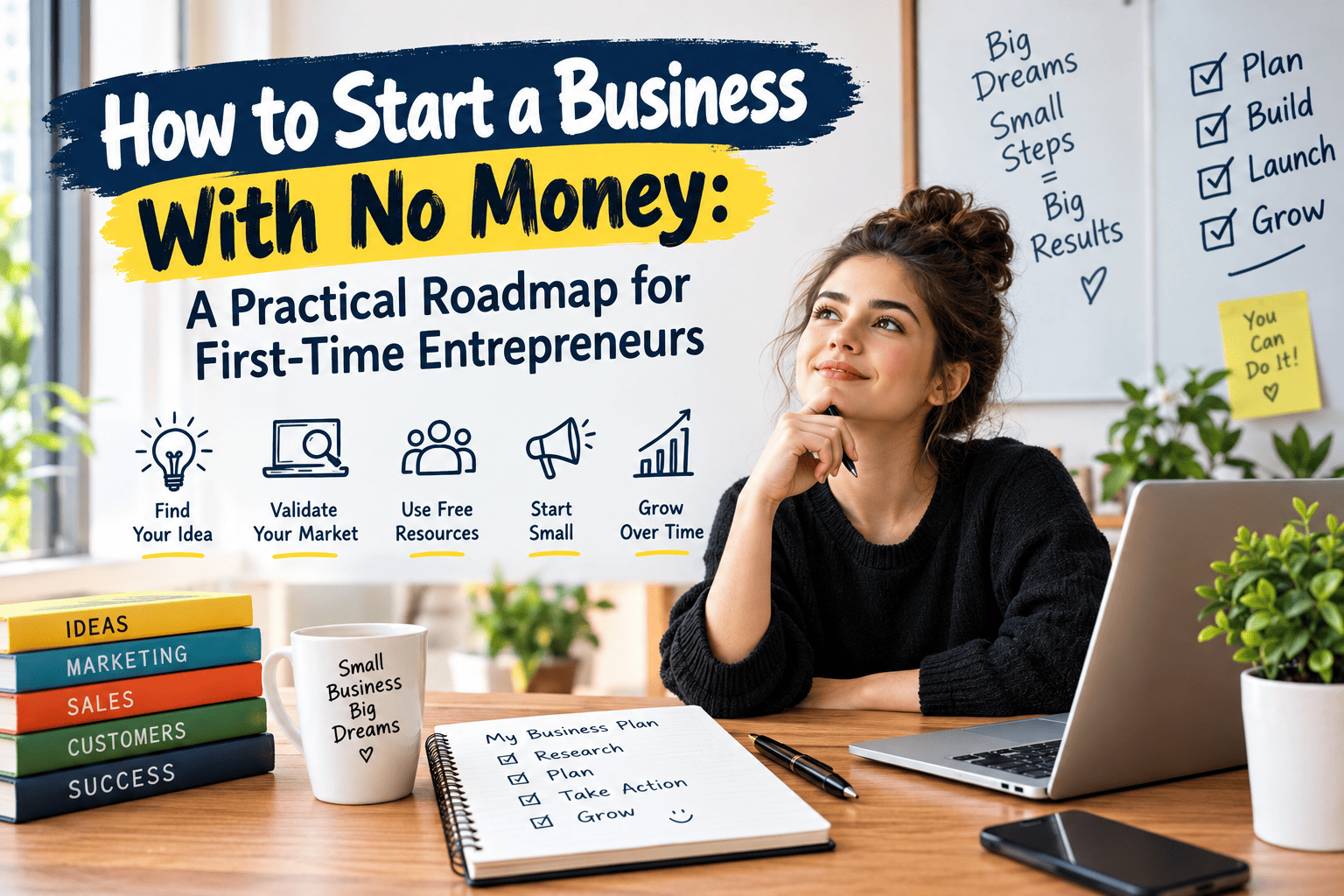
You can start a business with little or no money by choosing a service-based or digital business that uses skills you already have. Instead of investing heavily in inventory, office space, or expensive equipment, begin with free tools, validate your idea, find your first customers, and reinvest your early revenue into growth. The key is to start small, solve a real problem, and focus on generating your first sale before trying to build a large company.
Introduction
Starting a business sounds expensive when you think about everything a traditional company might need: an office, employees, inventory, professional equipment, advertising, software, and a large marketing budget. However, modern entrepreneurship has changed the way people can build businesses. A laptop, smartphone, internet connection, useful skill, and a good idea can sometimes be enough to get started.
If you are wondering how to start a business with no money, the most important thing is to change your approach. You do not necessarily need to create a large company from day one. Instead, you can begin with a simple service, digital product, freelance offer, or small online business and gradually build it into something more substantial.
The goal at the beginning is not to look like a big company. Your first goal should be finding a real problem that people are willing to pay you to solve. Once you understand your customer and make your first sales, you can use that revenue to improve your service, purchase better tools, develop your brand, and expand your business.
Can You Really Start a Business With No Money?
Yes, but “no money” does not mean that every type of business can be launched completely free. Some businesses require equipment, inventory, licenses, transportation, or other expenses. The smarter strategy is to choose a business model where the initial costs are extremely low and where you can generate revenue before making major investments.
Service businesses are particularly useful for beginners because you are selling your knowledge, time, creativity, or skills instead of buying products in advance. Freelancing, writing, graphic design, tutoring, virtual assistance, social media management, consulting, editing, and certain local services can all be started on a small scale.
Another advantage of starting lean is that you reduce financial risk. Instead of spending your savings on an idea that has not been tested, you can first determine whether customers actually want what you are offering. If people show interest and start paying, you have evidence that the business deserves further investment.
Step 1: Start With a Skill You Already Have
One of the easiest ways to launch a business without significant capital is to start with something you already know how to do. Think about your professional skills, hobbies, school or work experience, technical abilities, creative talents, and everyday problems you know how to solve.
For example, someone who writes well could offer content writing or proofreading services. A person who understands social media could help small businesses manage their social profiles. Someone good at mathematics could provide tutoring. A person with design skills could create logos, social graphics, presentations, or other visual materials.
Your first business does not have to be your lifelong career. It can simply be a starting point that teaches you how to find customers, communicate with clients, price your work, deliver results, and manage money.
Step 2: Find a Problem People Will Pay to Solve
A business idea becomes more valuable when it solves a genuine problem. Instead of asking only, “What business should I start?” ask, “What problem can I solve for someone?”
Businesses exist because customers want better, faster, easier, cheaper, or more convenient solutions. If you can identify a problem and offer a useful solution, you have the foundation of a business.
Look around your community and online spaces for recurring complaints and requests. Small businesses may need help creating content. Parents may need tutoring services. Busy professionals may need administrative assistance. Local companies may need better websites or social media content. Online creators may need video editing or graphic design.
The more clearly you understand the problem, the easier it becomes to explain why someone should pay for your service.
Step 3: Choose a Low-Cost Business Model
Your business model matters greatly when your starting budget is limited. A traditional retail business may require inventory, storage, packaging, and shipping. A service business may require almost none of those things.
Some low-cost business models include freelance services, online tutoring, consulting, virtual assistance, content creation, digital marketing, website services, graphic design, writing, editing, photography, home-based services, and digital products.
You can also explore models such as print-on-demand or affiliate marketing, although these still require time, learning, and marketing effort. The important point is to understand the costs and expectations of each model before committing your limited resources.
Step 4: Validate Your Business Idea Before Spending Money
One of the biggest mistakes new entrepreneurs make is spending money before confirming that customers actually want the product or service.
You can test an idea without building a complicated website or ordering large quantities of products. Talk to potential customers. Ask what they currently use, what they dislike about existing solutions, what they would like improved, and whether they would consider paying for a better option.
You can also offer a simple version of your service to your first few customers. Their feedback can help you improve your offer before you invest heavily.
This process is called business idea validation, and it can save beginners from wasting time and money on ideas that have little market demand.
Step 5: Create a Simple Offer
Once you know what problem you want to solve, turn your skill into a clear offer. Avoid making your service confusing or overly broad.
For example, instead of saying, “I do digital marketing,” you could say, “I help local restaurants create and manage their social media content.” The second statement makes the target customer and service much clearer.
A strong offer should explain three basic things: who you help, what you provide, and what result you aim to create. You do not need complicated branding or a long sales presentation in the beginning. Clarity is often more valuable than complexity.
Step 6: Use Free Tools to Build Your Business
When money is limited, free tools can help you handle many basic business tasks. You may be able to use free communication platforms, document editors, design tools, scheduling software, cloud storage, social media platforms, and basic website-building options.
However, do not fall into the trap of spending all your time searching for tools. Tools are only useful when they help you complete real business tasks.
Your first priority should be finding customers and delivering excellent work. A simple system that works is better than a complicated collection of software that consumes your time.
Step 7: Build an Online Presence Without a Big Budget
You do not need an expensive website to begin establishing credibility. Depending on your business, a professional social media profile, online portfolio, business listing, or simple landing page may be enough to start.
Your online presence should clearly communicate what you do and who you help. Include examples of your work whenever possible. If you do not have previous clients, create a few sample projects to demonstrate your abilities.
For example, a beginner graphic designer can create sample designs. A writer can create sample articles. A social media manager can prepare sample posts. A web designer can build a demonstration website.
These examples give potential customers something concrete to evaluate.
Step 8: Get Your First Customers
Getting the first customer is often harder than serving the tenth customer because you do not yet have a reputation or collection of testimonials.
Start with people and businesses within your network. Let friends, relatives, former colleagues, classmates, local businesses, and professional contacts know what you are offering. You can also participate in relevant online communities where your potential customers spend time.
Do not simply send generic promotional messages to everyone. Personalize your communication and focus on the problem you can solve.
For example, if you offer social media services, you could point out an opportunity you noticed on a business’s existing profile and explain how you could help improve its content strategy.
Step 9: Focus on Your First Sale Instead of Perfection
Many beginners spend weeks designing logos, choosing business names, building websites, and researching competitors while avoiding the most important activity: selling.
Your first objective should be simple—get someone to pay for your solution.
Your first version will probably not be perfect, and that is normal. Customer feedback can teach you more than endless planning. Once you have real customers, you can identify what works, what needs improvement, and what people are actually willing to pay for.
Starting imperfectly is often better than waiting indefinitely for the perfect business plan.
Step 10: Price Your Service Carefully
Pricing can be challenging when you are starting from zero. Charging too little can make it difficult to sustain your business, while charging too much without demonstrating value can make it harder to attract your first customers.
Research what similar providers charge and consider the time, effort, complexity, and value involved in your work. Your initial pricing does not have to remain permanent.
As your skills, results, reputation, and demand increase, you can adjust your pricing accordingly.
Avoid competing only on price. A business that becomes known for being the cheapest may struggle to increase prices later. Instead, focus on providing clear value and a reliable customer experience.
Step 11: Reinvest Your First Revenue
When you make your first money, it can be tempting to spend it immediately. A better approach is to use at least part of your early revenue to strengthen the business.
You might invest in better equipment, useful software, professional training, advertising, website improvements, business registration, or other resources that directly support growth.
Think of your first revenue as fuel. Reinvesting wisely can help turn a small side business into a more reliable source of income.
Step 12: Use Free Marketing Before Paid Advertising
You do not need a large advertising budget to begin marketing a new business. Content marketing, social media, networking, referrals, direct outreach, community participation, and useful educational content can all help you reach potential customers.
Create content that answers questions your target audience is already asking. Demonstrate your expertise instead of constantly telling people to buy from you.
For example, a bookkeeping service could publish simple financial organization tips for small businesses. A fitness professional could share general educational content about healthy routines. A web designer could explain common website mistakes.
Useful content can gradually build trust and introduce your business to people who may eventually become customers.
10 Low-Cost Business Ideas for Beginners
If you are still deciding what type of business to start, consider models that rely primarily on skills rather than expensive inventory.
Freelance writing: Businesses, websites, and creators often need articles, website copy, product descriptions, and other written content.
Graphic design: If you have design skills, you can create social media graphics, presentations, promotional materials, and branding assets.
Virtual assistance: Entrepreneurs and small companies may need help with scheduling, research, organization, customer communication, or administrative tasks.
Online tutoring: Knowledge in a particular subject can potentially be turned into a tutoring service.
Social media management: Small businesses often need help planning, creating, and organizing social media content.
Video editing: Creators, businesses, and organizations may need short-form and long-form video editing.
Translation services: If you are proficient in multiple languages, translation can be a useful service-based business.
Consulting: People with valuable professional knowledge can package their expertise into focused consulting services.
Digital products: Templates, guides, educational resources, and other digital products can be created once and sold repeatedly, although they still require research and marketing.
Local services: Depending on your skills and circumstances, cleaning, organizing, tutoring, pet care, photography, or other local services may provide a simple starting point.
Common Mistakes to Avoid When Starting With No Money
Starting with a limited budget makes it especially important to avoid unnecessary expenses. One common mistake is buying expensive equipment before earning any revenue. Unless the equipment is essential to delivering your service, consider starting with what you already have.
Another mistake is trying to serve everyone. A narrow target audience can make your marketing message much clearer. You can always expand later.
Some beginners also change their business idea every few weeks. Experimentation is useful, but constantly switching directions prevents you from collecting enough information to determine whether an idea can work.
Finally, do not underestimate the importance of customer service. A satisfied customer can provide repeat business, referrals, testimonials, and valuable feedback without requiring a large marketing budget.
How to Grow a Business After Your First Customers
Once you have several paying customers, your focus should gradually move from simply finding work to creating a repeatable business system.
Track where your customers come from, which services sell best, how much time you spend on each project, and which activities generate the strongest results. This information can help you make better decisions.
You can also create packages instead of selling every service separately. Standardized packages can make it easier for customers to understand your offer and easier for you to deliver consistent work.
As demand increases, consider whether certain tasks can be automated, outsourced, or simplified. Growth does not always mean working more hours. A successful business should gradually become more efficient.
How to Create a Simple Business Plan With No Money
You do not need a 50-page business plan to begin. A simple one-page plan can be enough for your first stage.
Write down the problem you are solving, your target customer, your main service or product, your expected price, how you will find customers, your estimated costs, and your first revenue goal.
Then identify what you need to accomplish during the next 30 days. Having a short-term plan prevents you from becoming overwhelmed by long-term goals.
Your plan should change as you learn. A business plan is a working document, not a permanent prediction of the future.
A Simple 30-Day Roadmap for First-Time Entrepreneurs
During the first week, choose one business idea based on your existing skills and research the problem it solves. Identify your ideal customer and study what alternatives are already available.
During the second week, create a basic offer and several examples of your work. Set up the essential online profiles or portfolio pages you need and prepare a simple way for customers to contact you.
During the third week, begin outreach. Contact potential customers, participate in relevant communities, publish useful content, and ask your existing network for referrals.
During the fourth week, focus on converting interest into your first paying customers. Deliver excellent work, collect feedback, improve your offer, and document the results you create.
This approach gives you something much more valuable than endless planning: real-world information about your market.
What If You Have No Experience?
Lack of experience does not necessarily mean you cannot start. You can build experience by creating sample projects, helping someone with a small project, completing practical courses, volunteering your skills, or working on personal projects.
The important thing is not to pretend that you have experience you do not have. Instead, demonstrate what you can actually do.
A portfolio can sometimes communicate your abilities more effectively than simply saying that you are skilled. Create useful examples and continue improving them as you gain real customer experience.
When Should You Spend Money on Your Business?
Spend money when the expense has a clear purpose and can reasonably improve your ability to operate or grow.
For example, paying for a tool that saves substantial time may make sense once you have revenue. Investing in better equipment may make sense when your current equipment limits the quality of your work. Paid marketing may make sense after you understand which offer converts customers.
Avoid spending simply because professional businesses appear to have expensive branding, offices, equipment, or software.
Your business should earn the right to become more expensive.
Final Thoughts
Learning how to start a business with no money is less about finding a magical business idea and more about learning how to start lean. Choose a problem, use the skills and resources you already have, test demand, create a simple offer, find your first customer, and reinvest your early revenue.
You do not need to build a large company immediately. Your first objective can simply be proving that someone is willing to pay for the solution you provide. From there, every customer, project, mistake, and piece of feedback can help you build a stronger business.
The biggest advantage of starting small is that you can learn without taking on unnecessary financial risk. If you stay focused, provide genuine value, manage your money carefully, and continue improving your offer, a business that begins with very little can gradually become a sustainable venture.
Frequently Asked Questions
1. Can I really start a business with no money?
Yes, some businesses can be started with almost no upfront investment, particularly service-based businesses. Your main resources may be your skills, time, internet access, and existing equipment.
2. What is the easiest business to start with no money?
There is no single easiest business for everyone. A service based on a skill you already possess is often one of the simplest starting points because you do not need to purchase large amounts of inventory.
3. How can I get my first customer without advertising?
You can use personal networking, referrals, social media, online communities, direct outreach, and useful content. Demonstrating your skills through sample work can also help establish credibility.
4. Should I create a website before starting my business?
Not necessarily. A website can be useful, but it should not prevent you from starting. Depending on your business, a simple portfolio or professional social profile may be enough initially.
5. What should I do with my first business income?
Consider keeping part of it as a reserve and reinvesting another portion into resources that directly improve your business, such as equipment, software, education, marketing, or customer acquisition.
6. How long does it take to make money from a new business?
There is no guaranteed timeline. Results depend on the business model, demand, skills, marketing, pricing, competition, and consistency. Some people generate revenue quickly, while others require considerable testing and development.
7. Do I need a business plan to start?
A detailed plan is not always necessary at the beginning. A simple plan covering your customer, problem, offer, pricing, marketing method, costs, and first revenue goal can provide a useful starting point.
8. What is the biggest mistake beginners make?
One major mistake is spending too much time preparing and too little time talking to potential customers. Testing your idea early can help you discover what people actually need before you invest heavily.
Conclusion
Starting a business without a large budget is challenging, but it is possible to begin much smaller than many first-time entrepreneurs imagine. The strongest approach is to start with what you already know, solve a specific problem, validate your idea, and focus on getting your first customer.
Instead of waiting until you have perfect resources, use the resources available today. Start small, learn from real customers, reinvest carefully, and build step by step. That practical approach can turn a simple idea into a real business without requiring a huge amount of money at the beginning.
[…] Growth: Proven Strategies to Scale Your Company and Increase Revenue How to Start a Business With No Money: A Practical Roadmap for First-Time Entrepreneurs Online Business Ideas: The Ultimate Guide to Starting a Profitable Business Online Small […]