

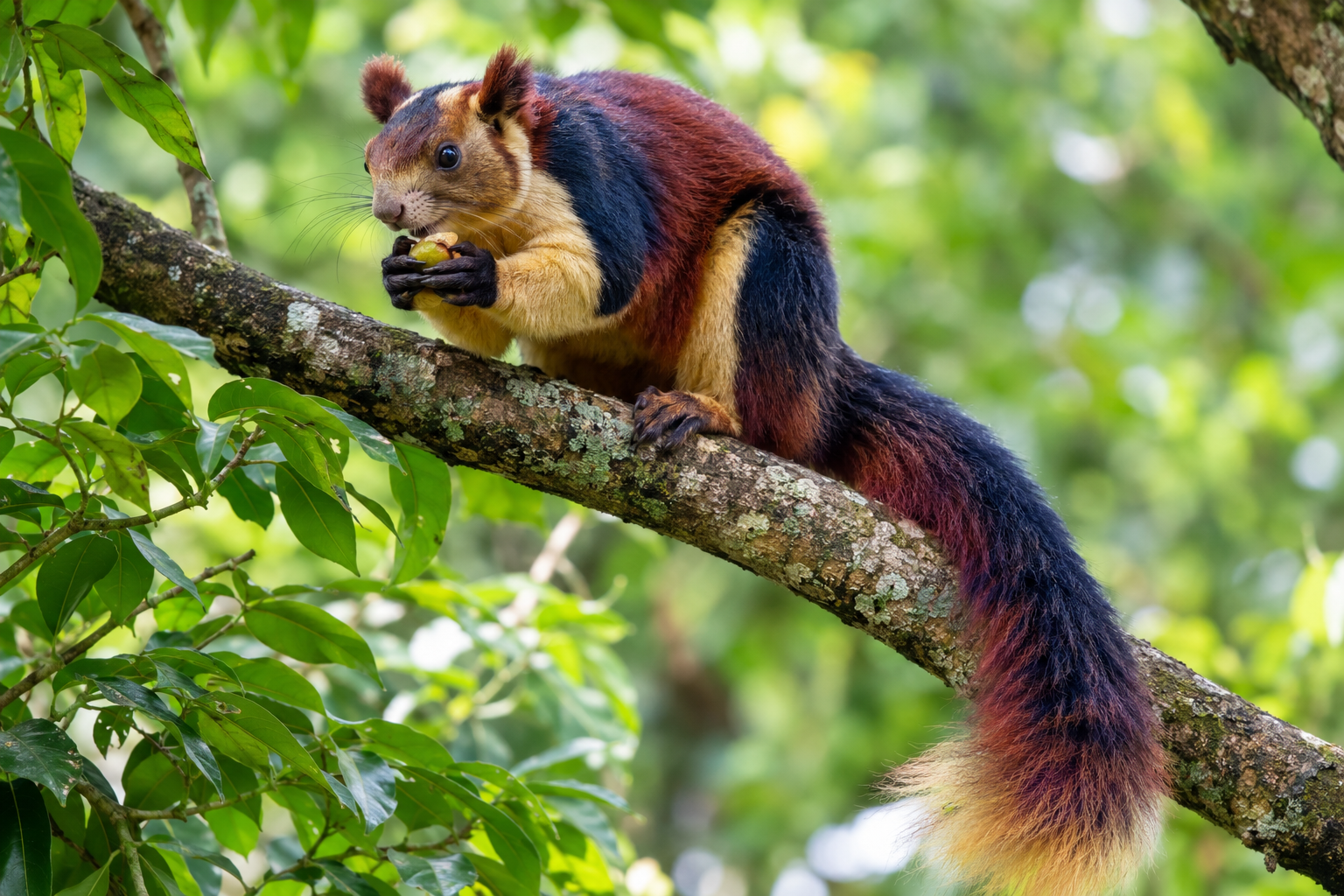
The giant squirrel is a fascinating tree-dwelling mammal known for its large body, colorful fur, bushy tail, and cautious behavior. Found in forests across parts of South and Southeast Asia, these squirrels spend much of their lives in trees, where they find food, build nests, and seek protection from predators. Their shy nature and preference for dense forest canopies make them difficult to observe. Understanding their habits reveals how these remarkable animals survive and contribute to the health of forest ecosystems.
Introduction
The giant squirrel is one of the most fascinating mammals living in tropical and subtropical forests. Unlike familiar squirrels that frequently visit gardens, parks, and bird feeders, giant squirrels generally prefer forest environments where tall trees provide food, shelter, and protection. Their striking appearance, impressive climbing skills, and cautious behavior make them particularly interesting to wildlife enthusiasts and nature researchers.
The description “secretive and shy” captures an important aspect of their lifestyle. Giant squirrels often remain high above the forest floor, where thick leaves and tangled branches conceal their movements. When they detect an unusual sound or movement, they may pause, observe their surroundings, or retreat into dense foliage. These behaviors help them avoid danger and explain why spotting one in the wild can be challenging.
What Is a Giant Squirrel?
A giant squirrel is a large tree-dwelling rodent belonging to the squirrel family, Sciuridae. Several species are known as giant squirrels, including the Indian giant squirrel, Malayan giant squirrel, and grizzled giant squirrel. Although their appearance and distribution vary, these animals share several characteristics, including strong limbs, sharp claws, long bodies, and bushy tails that support their movement through trees.
The Indian giant squirrel, scientifically known as Ratufa indica, is particularly famous for its colorful fur. Depending on the individual, its coat may feature shades of reddish brown, maroon, orange, cream, and dark brown. Its long tail helps maintain balance while climbing and jumping between branches. These physical features distinguish it from many smaller squirrel species and make it one of the most recognizable mammals in its natural habitat.
Why Is the Giant Squirrel So Secretive and Shy?
The giant squirrel’s cautious behavior is closely connected to survival. Forest environments contain natural predators and other potential dangers, so remaining alert is essential. When a squirrel notices unfamiliar movement, it may stop feeding, remain still, or quickly move toward thicker vegetation. Avoiding unnecessary exposure can help reduce the risk of becoming a predator’s target.
Another reason these animals appear secretive is their preference for elevated branches. People walking through a forest usually look toward the ground or along nearby trails, while giant squirrels may be moving far above them. Dense leaves, branches, and shadows make their bodies difficult to distinguish from the surrounding vegetation, especially when they remain motionless.
Their shy nature does not mean they are inactive. Giant squirrels spend considerable time feeding, climbing, exploring their surroundings, and maintaining access to suitable nesting sites. They simply carry out many of these activities in locations where people are less likely to see them.
Natural Habitat of the Giant Squirrel
Giant squirrels depend on forests that provide mature trees, diverse food sources, suitable nesting locations, and connected branches. The Indian giant squirrel lives in parts of peninsular India, including areas of the Western Ghats, Eastern Ghats, and central Indian forests. Other species occupy different parts of South and Southeast Asia, with each species adapted to its particular environment.
Tall trees are especially important because they provide both food and protection. Large branches allow squirrels to travel through the canopy, while dense foliage creates hiding places. Connected tree crowns can also help them move between feeding areas without repeatedly descending to the forest floor.
The quality of their habitat influences their ability to survive. Forests with a variety of native tree species may provide more consistent food supplies throughout the year. However, when forests are cleared or divided into isolated patches, squirrels can lose important feeding locations and safe routes between trees. Maintaining suitable forest cover is therefore essential for their long-term survival.
What Does a Giant Squirrel Eat?
Giant squirrels have varied diets that reflect the food available in their surroundings. Depending on the species, they may eat fruits, nuts, seeds, flowers, buds, leaves, and tree bark. Some species also consume insects and other small animal materials, including bird eggs. Their food choices can change with the seasons as plants produce different fruits, seeds, and flowers.
Their feeding habits demonstrate how effectively they use the forest canopy. A squirrel may sit on a branch and hold food between its front paws while eating. Strong teeth help it process hard seeds and other plant materials. By feeding on different trees, it can take advantage of changing food supplies across its habitat.
Food availability also influences movement. When a particular tree produces abundant fruit, a squirrel may spend more time feeding nearby. As supplies decrease, it may travel to other trees in search of suitable alternatives. This flexibility helps giant squirrels obtain the nutrients they need while remaining within their preferred forest environment.
How Giant Squirrels Move Through Trees
One of the most impressive characteristics of giant squirrels is their ability to move confidently through the forest canopy. Their powerful limbs, sharp claws, and flexible bodies help them grip tree trunks and branches. They can climb vertically, change direction, and jump between suitable branches when the distance and landing conditions allow.
Their bushy tails serve as important balancing structures during movement. When a squirrel travels along a narrow branch or lands after a jump, its tail helps it maintain stability. This adaptation is particularly valuable in forests where branches vary in thickness, height, and direction.
It is important to distinguish ordinary giant squirrels from giant flying squirrels. Indian giant squirrels mainly travel by climbing and jumping, whereas flying squirrels possess a membrane between their limbs that allows them to glide from one tree to another. Although both groups are adapted to life in trees, their movement strategies are different.
Daily Routine and Activity Patterns
Many giant squirrels are primarily active during daylight hours. They use this time to search for food, move between trees, inspect their surroundings, and rest in sheltered locations. Their activity patterns can vary depending on the species, weather, food availability, and local environmental conditions.
Morning and late afternoon may provide useful opportunities to observe some giant squirrels. However, their routines are not identical across all habitats. During periods of intense heat or disturbance, an individual may spend more time resting in shaded locations. When conditions become favorable, it can resume feeding and traveling through the canopy.
Their daily routine reflects a balance between obtaining food and avoiding danger. Giant squirrels must locate suitable resources while remaining aware of their surroundings. Because they frequently stay high above the ground, observing these activities often requires patience and careful attention to movement among branches.
How Giant Squirrels Build Their Nests
Giant squirrels commonly construct nests from leaves, twigs, and other plant materials. These structures, often called dreys, are generally positioned among branches high above the ground. Depending on the species and its surroundings, a squirrel may build or use more than one nest, providing alternative places to rest or seek shelter.
Nest placement is important because a suitable tree provides structural support, protection from exposure, and convenient access to food. Dense branches may conceal the nest from predators and reduce its visibility from below. Some nests are built in forks where several branches create a stable foundation.
Nests also play an important role in reproduction. A protected location gives a female a place to care for her young while limiting exposure to disturbances. The construction and use of elevated nests demonstrate how strongly giant squirrels depend on the structure and quality of their forest habitat.
Communication and Warning Signals
Although giant squirrels often spend much of their time alone, they are not completely silent. Depending on the species and situation, they may produce sharp calls or other vocal sounds when alarmed. These sounds can communicate the presence of a possible threat to nearby animals.
Body posture and movement may also reveal changes in their behavior. A squirrel that suddenly stops feeding, changes direction, or retreats into thick foliage may have detected something unusual. These reactions can be easy to overlook because the animal’s natural response is often to avoid drawing attention to itself.
Communication works alongside other survival adaptations. Keen senses, familiarity with the local canopy, and access to hiding places help giant squirrels respond to changing conditions. Their behavior demonstrates the importance of awareness in an environment where danger can come from multiple directions.
Reproduction and Family Life
Giant squirrels generally spend considerable time alone, although individuals may come together during breeding periods. Their social behavior varies by species, and observations from one population should not automatically be applied to every type of giant squirrel.
Females typically use protected nesting sites when caring for their young. These nests provide a sheltered environment during early development, when young squirrels depend on parental care. As they grow, they gradually develop the strength, coordination, and climbing skills needed to move through the trees.
Detailed reproductive information is not equally available for every species. Researchers continue to investigate breeding behavior, population patterns, and habitat requirements, particularly among species living in restricted or fragmented forest environments. Understanding these factors can help conservation teams determine what different populations need to survive.
The Giant Squirrel’s Role in Forest Ecosystems
Giant squirrels contribute to forest ecosystems through their feeding and movement patterns. When they eat fruits and seeds, they may transport seeds away from parent plants. Some seeds fall during feeding or are carried to different locations, potentially supporting plant reproduction and forest regeneration.
The extent of this contribution depends on the squirrel species, the plants available, and local environmental conditions. Seed dispersal does not guarantee that every seed will develop into a healthy tree, but it can form part of the natural process through which forests renew themselves.
Giant squirrels are also part of the forest food web. Various predators may hunt them, making them one component of the ecological relationships connecting plant-eating animals and carnivores. Protecting their habitat can therefore benefit other organisms that depend on the same forest environment.
Threats Facing Giant Squirrels
Despite their ability to remain hidden, giant squirrels face environmental pressures that cannot always be avoided. Habitat loss is a major concern where forests are cleared or transformed for agriculture, roads, buildings, and other human activities. Losing mature trees reduces the availability of food, nesting locations, and safe routes through the canopy.
Forest fragmentation creates another challenge. When continuous woodland is divided into isolated patches, squirrels may find it harder to move between suitable areas. Gaps between trees can increase exposure to danger and limit access to essential resources. These difficulties can be especially serious for species that depend on specific forest types or have restricted geographical ranges.
Hunting and other forms of human disturbance can also affect certain populations. The severity of these threats differs across species and regions. Conservation efforts therefore need to consider reliable local evidence and the particular needs of each species rather than treating all giant squirrels as equally threatened.
How Can Giant Squirrels Be Protected?
Protecting natural forest habitat is one of the most important ways to support giant squirrel populations. Conservation programs can prioritize mature trees, diverse native vegetation, and connected canopy routes that allow animals to move between feeding and nesting areas. Preserving existing forests is especially valuable because large trees can take many years to replace.
Wildlife monitoring also helps conservation teams understand where populations occur and how their habitats are changing. Field observations, photographs, and scientific surveys can reveal patterns in feeding, nesting, and movement. Local communities can contribute by reporting sightings and supporting responsible forest management practices.
Visitors can help by observing wildlife from a respectful distance, avoiding unnecessary noise, and never attempting to capture or handle wild squirrels. Feeding wild animals is generally unnecessary and may interfere with their natural behavior. Allowing giant squirrels to continue their daily activities without disturbance is one of the simplest ways to appreciate them responsibly.
Interesting Facts About the Giant Squirrel
The giant squirrel stands out among tree-dwelling mammals for its large body, long bushy tail, and sometimes vivid fur colors. Certain species display combinations of reddish, brown, cream, and darker shades that appear particularly striking when sunlight reaches the forest canopy. These physical characteristics make them distinctive even though their cautious behavior often keeps them out of sight.
Another interesting feature is their ability to handle food while perched on branches. Their front paws help hold food, their teeth process hard materials, and their claws provide a secure grip. These adaptations work together to support a lifestyle centered on climbing, feeding, and resting among trees.
Their nests are equally remarkable. Giant squirrels may use multiple leafy structures positioned high in trees, depending on their needs and surroundings. These elevated shelters offer resting places and can support reproductive behavior. Together, their physical features and habits demonstrate how specialized these animals are for life in forest canopies.
Frequently Asked Questions
1. Why is the giant squirrel considered secretive and shy?
Giant squirrels often remain high in the forest canopy and avoid unnecessary contact with people. Their cautious behavior, preference for dense vegetation, and ability to remain still among branches make them difficult to observe in the wild.
2. Where do giant squirrels live?
Different giant squirrel species live in parts of South and Southeast Asia. The Indian giant squirrel inhabits forest regions of peninsular India, while other species occur in different geographical areas. Most depend on trees for food, movement, and shelter.
3. What is the main food of a giant squirrel?
Their diets commonly include fruits, nuts, seeds, flowers, buds, and other plant materials. Depending on the species and local food supply, some giant squirrels also consume insects or bird eggs.
4. Are giant squirrels endangered?
Conservation status varies by species. Some giant squirrel species face significant habitat pressures, while others have different conservation assessments. Habitat destruction and fragmentation are important concerns for certain populations, making species-specific assessments essential.
5. Do giant squirrels come down to the ground?
Giant squirrels spend most of their time in trees, but some may descend when necessary. They generally benefit from remaining in the canopy because it provides convenient access to food, shelter, and routes between branches.
6. How can you spot a giant squirrel in the wild?
Look for movement among tall trees in suitable forest habitat, particularly when squirrels are feeding or traveling between branches. Early morning or late afternoon may provide good opportunities in some locations. Use binoculars if available and observe quietly from a distance.
Conclusion
The giant squirrel is a remarkable example of how wildlife adapts to life in the forest canopy. Its cautious nature, climbing ability, varied diet, and elevated nests help it survive in an environment filled with both opportunities and challenges. Although its secretive behavior makes it difficult to observe, studying its habits provides valuable insight into forest ecology.
Protecting giant squirrels requires more than preserving individual animals. Healthy forests, mature trees, connected habitats, and responsible wildlife observation are all important for their long-term survival. By understanding why these animals remain hidden and how they depend on their surroundings, people can better appreciate their ecological importance and support the conservation of the forests they call home.